Monday, March 23, 2015

Review: The Cure for Dreaming by Cat Winters

Title: The Cure for Dreaming

Author: Cat Winters

Information on series: Not part of a series

Audience:  Young Adult

Rating (scale of 1-5, with 5 being highest): 3.5

TL;DR: Historical fiction with a hint of fantasy. Highlights the struggle for women’s suffrage at the turn of the last century.

Longer review: This is Cat Winter’s second historical fiction book for a YA audience that has some fantasy/paranormal element. This book is set in 1900 in Portland, Oregon. The protagonist, Olivia Mead, is a pro-suffrage teenager who is struggling to assert her opinions or gain any freedom from her domineering and anti-suffrage father.

Olivia is chosen to be hypnotized by Henri Reverie on Halloween night (also her birthday, this fact plays a very minor role).  Olivia’s father sees this in the paper and hires Henri to hypnotize Olivia into more “ladylike” tendencies.  Instead, Henri tells Olivia to “see the world as it is.” This results in Olivia seeing her father as a vampire (her favorite book is Bram Stoker’s Dracula) and suffragettes with a heavenly glow.  Of course, there is a romantic element between Olivia and Henri. Together they team up to affect change and advance the efforts toward universal suffrage.

This book is a good introduction to fantasy for those who would not normally be inclined to read fantasy. The fantasy element is present, but there is no real world building beyond contextualizing the historical setting. Some of the message about free speech and rights is a little heavy handed at times, but that does go along with the storyline. Overall, it’s a quick read that may get some fantasy readers to learn about history or get some history lovers to appreciate the freedoms fantasy writing allows (humans doing things that they normally cannot).  The romantic element is fairly chaste and is suitable for older middle school readers.

Read alikes:
Life After Life—Kate Atkinson
The story of one girl’s life throughout the first half of the 20th century. This story is largely historical fiction but may appeal to fantasy readers. The main character dies several times throughout the book, but is either able to change the past to prevent the fate or mysteriously defeats death.

In the Shadow of Blackbirds-Cat Winters.
Has a similar style and tone to The Cure for Dreaming, but set in 1918 during the height of the spiritualist movement and the Spanish Influenza. Features haunting pictures of the era to drive home how devastating the flu really was.

Review by Olivia of the Ericson Public Library

Thursday, March 5, 2015

Review: The Southern Reach Trilogy by James VanderMeer

Title: The Southern Reach Trilogy

Author: James VanderMeer

Information on series: 3 titles: Annihiliation, Authority, and Acceptance

Audience: Adult

Rating (scale of 1-10): 9

TL;DR: Area X. Engulfing an ill-defined swath of land, sea and sky in the southern U.S., it appeared suddenly,cutting off all connections from the rest of the world. Eleven expeditions have been sent over the border, none have returned unscathed, And yet, the agency that oversees each of these doomed expeditions – The Southern Reach – prepares a twelfth expedition.


Readalikes: Crouch End by Stephen King, H.P. Lovecraft

Longer Review:
Area X. Engulfing an ill-defined swath of land, sea and sky in the southern U.S., it appeared suddenly, cutting off all connections – human, animal and otherwise – from the rest of the world. The government sends team after team – scientific and military – into Area X. Some disappear without a trace, others return badly damaged and still others return seemingly unharmed, only to die weeks or months later. Most communication and recording instruments are rendered useless once the border is crossed, the footage that does survive only deepens the mystery – and the growing horror – of Area X. Still, the agency that oversees each of these doomed expeditions – The Southern Reach – prepares a twelfth expedition.

VanderMeer’s Southern Reach Trilogy opens with Annihilation (February 2014) as four women – an anthropologist, a surveyor, a psychologist and a biologist – are sent into Area X. Neither the author nor the narrator (the biologist) use names, instead the characters are defined only by their professions, lending a clinical and dispassionate air to the narrative. Even though we observe the others and Area X through the biologists’ eyes, even she remains somewhat removed from us and from her team. But instead of alienating the reader from the narrator, it lends an odd kind of intimacy that continues throughout the trilogy.

The second book, Authority (May 2014) is told from the point of view of a man called only Control, who has been put in charge of The Southern Reach soon after end of the twelfth expedition –  and the investigation into its fate – as Area X appears to infiltrate (or contaminate, depending on your perspective) the world outside its borders. The third book, Acceptance (September 2014) returns us to Area X and the similarly inscrutable organization attempting to oversee, explain and control it.

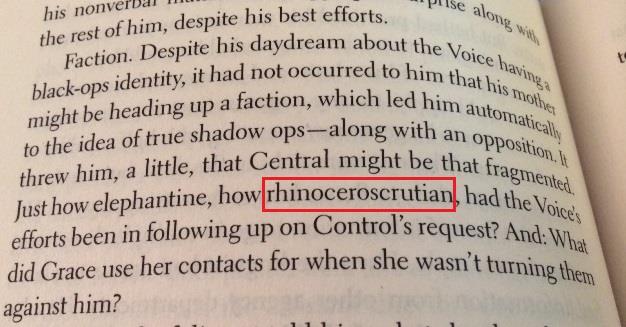
The language VanderMeer uses is  deeply atmospheric and complex, at times, maddeningly so*, although here in Area X it is entirely appropriate. Area X itself defies explanation and even description, as if our view of it through the eyes of our semi-anonymous characters was obscured, with unseen or unknowable dimensions hovering right at the edge of our perception. This dawning horror of the unknown creates and maintains a nearly intolerable level of suspense as layer after layer  is peeled back – at times reluctantly – exposing and obscuring Area X and the people drawn into its influence.

This series is one of those that you’ll want (or in my case, need) to read more than once and even then, it stays with you. It reminds me of Stephen King’s short story Crouch End, or anything by Lovecraft. Even the cover art on the paperback editions is worth studying – and then hiding safely away, lest Area X escapes.

~ Allison

* In the middle of reading Authority, I came across this word and had to share it.
10006109_10204247464529226_578602301698060360_n

Wednesday, February 4, 2015

Review: The First Fifteen lives of Harry August by Claire North

Author: Claire North (pseudonym for Catherine Webb)
Information on series: Stand alone
Audience: Adult
Read alikes: Replay, by Ken Grimwood; Life after life by Kate Atkinson; The impossible lives of Greta Wells by Andrew Sean Greer; My real children by Jo Walton
Rating (scale of 1 – 10, with 10 being the highest): 7.5


Tl;dr: A bit of a time travel tale mixed with a dose of Choose your own Adventure, this science-fiction/fantasy blend follows our protagonist Harry August as he navigates his life over and over again.  Harry is a kalachakra, one who is reborn into the same life while retaining memories of past lives, and has recently received a message from the future: The world is ending, and Harry may be the only one who can stop it. 

“When I am optimistic, I choose to believe that every life I lead, every choice I make, has consequence. That I am not one Harry August but many, a mind flicking from parallel life to parallel life, and that when I die, the world carries on without me, altered by my deeds, marked by my presence.” 

Meet Harry August. Harry is a kalachakra, an ouroboran, one who is reincarnated time after time as the same person. He follows a parallel path through life, experiencing the same major events, only to die and do it all over again. How he chooses to live each life is up to him, and Harry wears many hats over the course of the book. Harry’s lives all begin the same: born in an English train station on New Year’s Day 1919 his mother dies in childbirth, taking with her the secret of his father’s identity. Harry is raised by a groundskeeper and his wife and during his third life is inducted into a secret society comprised of other kalachakra, known as the Cronus Club. Under the guidance of the Club, Harry is educated in the ways of the kalachakra: You cannot change major events, no murdering Hitler as a child or preventing JFK's assassination. A kalachakra may use their knowledge of sporting events or stock patterns and benefit financially from these endeavors, though they must bequeath a good portion of their profits to the Club for future generations. Club members can pass information along to future or past kalachakra, either by finding an elderly ouroboran about to pass away and verbally giving them a message to carry back in time, or by carving a note in stone to be read by kalachakra to come. It is in this first manner that Harry receives a chilling message on the death bed of his eleventh life; the world is ending, faster and more violently with each reincarnation, and it is up to him to find out why.  Throughout his next four lives Harry sets out to determine the cause of the world's demise, a task that carries him around the globe, across the paths of past friends, enemies, and lovers, and delves deep into questions of philosophy, morality, mortality, hard science, and religion. As the culprit of the world's end is made known the book shifts from an exploration of Harry's lives on an emotional and metaphysical level to a discussion of scientific and technological advancements and their role in humanity. 

Conceptually, I thought this book was fantastic. While it is certainly not the first novel to play with timelines I felt the way the author handled reincarnation (being born again as the same person with prior lives' memories intact) was refreshing. Harry's first person narration is nonlinear as the plot jumps from life to life, often without preamble, which may be disconcerting to some readers. The pacing is also erratic, alternating between frustratingly stagnant to page-turning, which lowered my overall enjoyment. There were also times where the scientific concepts were above my own (extremely limited) grasp of quantum physics, though if that's a fault of the book or my knowledge I cannot say. 


Overall I found The first fifteen lives of Harry August to be quite a delightful read. 

Tuesday, February 3, 2015

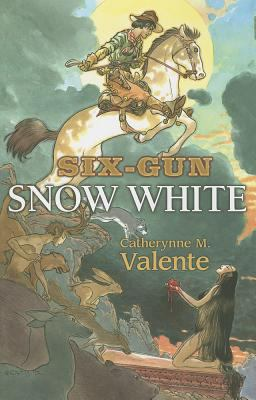
Review: Six-Gun Snow White by Catherynne M. Valente

 Title: Six-Gun Snow White

Author: Catherynne M. Valente

Information on series: Not part of a series

Audience: Adult, though with appeal for some older teens

Rating (scale of 1-5, with 5 being highest): 4.5

TL;DR: A violent, witty novella-length retelling of Snow White set in the Old West written with a very distinctive and lyrical narrative voice.

Longer review: My love of fairy tales brought me to the fantasy section as a child, and served as my gateway to dragons and wizards and all the rest. There is something magical about a well-written retelling that allows you to experience a familiar favorite, as if for the first time.

Catherynne M. Valente has drawn on myth and folklore in many of her award-winning novels and shorter fiction for both adults and younger readers (you might recognize her as the author of the middle-grade The Girl Who Circumnavigated Fairyland in a Ship of Her Own Making). Valente has described her style as “mythpunk” (Ć  la cyberpunk). Her Six-Gun Snow White is, no surprise, a retelling of Snow White set in the American Old West.

What made Valente’s retelling stand out for me was the narrative voice. It’s a distinctive, witty style with grammar and vocabulary that brought the Old West setting and characters to life. This could very easily have become a gimmick, but instead the style helped to underscore what Valente had to say about gender, race, and magic. In fact, this proved to be the sort of book where I found myself going back to reread passages and mark favorite quotes. I’ll limit myself to sharing two here:

“In my experience, folk find it nigh on impossible to call a thing what it is.” (page 10)

“You can tell a true story about your parents if you’re a damn sight good at sorting lies like laundry, but no one can tell a true story about themselves.” (page 69)

It’s a violent, bittersweet story that will appeal most to readers who look for language and style over plot and characters. A taste for dark humor would not go amiss either.

Read alikes:

Pretty Deadly by Kelly Sue DeConnick, Emma Rios, & Jordie Bellaire: This graphic novel is another fairy tale set in the Old West, though it is an original tale that rather than a one-for-one retelling. The story is complex, and the artwork is often stunning.


The Ocean at the End of the Lane by Neil Gaiman: Like Valente, Gaiman often draws on folklore and mythology for inspiration in his stories. The mythology in The Ocean at the End of the Lane is familiar in the way that nightmares are familiar. This is also a novella, and the writing is lyrical, though it’s a very different poetry.


Deerskin by Robin McKinley: McKinley wrote some of the first fairy tale retellings I ever read, so it’s possible I’m including this more from nostalgia than for its appeal factors. That said, Deerskin is a dark story of abuse, escape, and recovery lyrically told.

Wednesday, January 21, 2015

Review: Highfell Grimoires by Langley Hyde

Title: Highfell Grimoires  
Author: Langley Hyde
Information on series: Not part of a series
Audience: Adult
Rating (scale of 1-10): 5  - I wasted too much time trying to pick between 2 and 3 on a 5 point scale
TL;DR: In a steampunk-fantasy world of flying ships and ancient spells, a young man discovers his place in the world (and quite a bit of romance too).

Longer review:
When his parents die deep in debt, Cornelius ‘Neil’ Franklin and his sister Nora find themselves cast upon their uncle’s generosity.  For Nora it means an introduction to society as a prelude to being married off; for Neil it means a menial job teaching other orphans at Highfell Hall, a charity school owned by his uncle.  Raised to assume a position in the highest strata of society, and recently graduated from the finest of boarding schools, Neil keenly feels his loss in station but begins the book resolved to make a go of his new life.
The world of Highfell Grimoires is entirely fictional, taking place in an invented country, but is functionally Dickensian.  Imagining Victorian London as a starting point makes the author’s lack of world-building (for a fantasy novel) easier to handle.  Layered on top of this familiar world is a veneer of steampunk and fantasy elements.  Emanating from various spots in Hyde’s world is the magical aether, a substance that can be harnessed to power spells or machines.  Familiar steam-punk contraptions are powered here not by steam or clock-work, but by spell-infused engines which harness the power of the aether.
While lacking a bit in depth, the world of Highfell Grimoires does have two very interesting aspects.  The aether, with help from enchanted turbines, keeps gigantic ships floating in the skies.  These aetheria (the plural of aetherium) add a very literal, vertical stratification to the socially stratified society.  I thought it was a nice touch that the richest estates and best schools occupy grounds that aren’t just socially out of reach of the lower classes - they literally float high above the poorer sections of town.
The grimoires of the novel’s title are the second unique element Hyde brings to her world.  Each family keeps a book of spells passed down through the generations and sealed by a bloodlock, which only opens with a drop of blood from a family member.  Spells are written in metallic ink over pages embedded with wire.  When traced by a finger in the presence of the aether, a spell is cast.  Neil’s interest in spell-casting is largely academic.  He enjoys learning the ancient languages they’re written in more than actually performing magic, and unfortunately only two spells are actually cast during the entire novel.  The author really misses an opportunity to exploit her inventiveness in creating a cool system of magic.
Highfell is a lower aetherium, and though Neil tries to keep his expectations low, he doesn’t think nearly low enough.  His students are unusually smart, but are kept underfed and live in near-squalor.  He shares a dingy room with Leofa, a gruff and well-muscled man that identifies himself as the gardener (though there is no garden).  The school’s care-takers, the Nobbsnipe family, though they are clothed in the vestments and manners of the upper-classes, are immediately recognizable as one-note villains (to the reader, but not Neil, who is frustratingly slow to catch on to too many things throughout the novel).
As Neil begins to piece together some of the mysteries of Highfell Hall, he also begins to notice just how handsome he finds his roommate Leofa.  In fact, readers interested primarily in romance will find much to like in Highfell Grimoires despite its shortcomings elsewhere.  Neil, though naĆÆve, is intelligent, pure of heart and endearingly dorky, while Leofa begins gruff and mysterious, and only later reveals unexpected vulnerability.  Both of these characters, and their relationship, evolve convincingly and satisfyingly through the novel.
The plot moves quickly, but predictably.  Neil usually takes an extra chapter or two to catch onto things that the reader has already guessed.  The novel’s resolution is exceptionally clean.  Everything is tied up too neatly, and every character, good and bad, seems to get exactly what they deserve.  This makes the novel feel as if was written for a younger audience, even though Neil and Leofa’s relationship culminates in scenes too graphic for most YA readers.  Hyde’s writing is concise but descriptive.  She proves especially adept at describing Neil’s thoughts, and the conflict between his feelings for Leofa and his upbringing in a society that deplores homosexual relationships.  Unfortunately, Hyde’s editor did her no favors.  Sentences with obviously missing words are commonplace enough to be detrimental to the reading experience.
I chose to read Highfell Grimoires after seeing it listed as a starred review in the fantasy section of Publisher’s Weekly.  Perhaps these expectations made me rate the book lower than I should have.  Highfell Grimoires might not be an especially good fantasy novel, but it really functions well as a sort of new adult romance in a fantasy/steampunk setting.

Read alikes:
Boneshaker (and the rest of the Clockwork Century books) by Cherie Priest:  Readers who enjoyed Neal and Leofa as characters will like Priest’s main characters.  They tend to be interesting, multifaceted and non-traditional types cast as heroes.  Boneshaker’s Briar, a middle-aged widow and single mother with a checkered past, is a good example.  The series takes place against the backdrop of the American Civil War in a steampunk universe that has none of Highfell Grimoires’ magic, but does add zombies.

Leviathan (and the rest of the Leviathan trilogy) by Scott Westerfeld:  This young adult series throws together two very different teens on the verge of the First World War.  Westerfeld’s steampunk world is amazingly deep and original.  Fans of Highfell Grimoires may enjoy that much of the action takes place on an airship, and will certainly enjoy the romance (albeit a heterosexual, chaste one) that develops between the main characters.

Other Blind Eye Books:  Blind Eye Books, publisher of Highfell Grimoires, apparently specializes in sci-fi and fantasy titles featuring gay and lesbian characters.  While I haven’t read any, it seems likely that there are other titles in their catalog that will appeal to fans of Highfell Grimoires.

Wednesday, January 14, 2015

Review: Boneshaker by Cherie Priest

Title: Boneshaker
Author: Cherie Priest
Information on series: The Clockwork Century:  Book 1
Audience: YA, with adult crossover
Rating (scale of 1-5, with 5 being highest:  4
TL;DR: A fast-paced and character driven fantasy with steampunk, alternative history and zombies.

Longer Review: Set in the Pacific Northwest. In the early part of the civil war inventor Leviticus Blue is commissioned by Russian prospectors to build a machine that drills through ice. On the first test run Leviticus drilled through the foundation of several buildings down town, destroying them and unearthing a gas which causes those breathe it to turn into zombies.  Sixteen years later, the city is walled up.  Leviticus’ window, Briar, who has a tarnished reputation, is living in the outskirts.   Her son, 15 year old  Ezekiel has decided to sneak back into the city to prove that his Father that he never met wasn't such a bad guy after all.  Briar goes in after him and they both encounter wild inventions, a mad scientist, zombies and pirates along the way. 

This is well written.  Fans of fantasy will find lots here.  The emphasis is more on steampunk and less on the zombies.  The book  gets bogged down in detail in spots, so the reader may have to slow down to take it all in.  Most of the book is pretty action packed and it has strong characters.  Briar is a strong female protagonist.    There is a bit of a mystery element as to if Leviticus was really the evil person everyone thinks he was and Briar knows more than she is telling everyone including Ezekiel. 

Readalikes:
The Six Gun Tarot by R.S. Belcher: For the reader who wants to read more steampunk, zombies and alternate history. This takes place in an abandoned mine in Nevada.

The Havoc Machine by Stephen Harper: This is a fourth book in a series but can be read as a stand-alone. This has zombies, a mad scientist and a dangerous machine.

Monday, January 12, 2015

Review: Red Rising by Pierce Brown


Title:  Red Rising
 
Author: Pierce Brown

Information on the Series:  First in a planned trilogy

Audience: Adult, with YA Crossover


Rating: (on a scale from 1-5 with 5 being the highest)  4

TL;DR:  A tale set in a bleak future society torn by class divisions follows the experiences of secret revolutionary Darrow, who after witnessing his wife's execution by an oppressive government, joins a revolutionary cell and attempts to infiltrate an elite military academy.

Longer Review:  Pierce Brown’s debut novel Red Rising has drawn comparisons to The Hunger Games and Game of Thrones.  Full disclosure, I read The Hunger Games trilogy and thought it was okay, and I never finished Game of Thrones.  After reading the book I can see similar themes and story elements in Red Rising, but I feel that the book stands on its own merits. 

Brown has created a richly detailed fantasy world that takes place in a dystopian future, on Mars.  There is a distinctive class system, based upon colors.  Darrow is a Red, the lowest class on Mars.  The twist is that Darrow doesn’t actually live on Mars, he lives in Mars.  Reds are miners, they were sent to Mars to work below the surface in an attempt to make the planet habitable for humans because Earth is dying.  This process has been going on for generations.  The majority of Reds have been kept in the dark about the fact that there is a thriving community on the surface, they still believe that what they are doing is important for the future of colonization on Mars.  The life expectancy of a Red is very short due to the dangerous nature of their jobs. As a result, Reds marry quite young.  Darrow, and his wife Eo, are teenagers, 15 or 16 years old. Through a series of events, including the execution of his wife, Darrow ends up living on the surface with a rebel organization called the Sons of Ares. This organization is determined to bring down the elite Gold ruling class by any means necessary.  Darrow is reinvented and gains admission to the Institute, an elite military academy where the Gold families send their teenagers. 

Far from a posh school where students are pampered, the Institute is brutal.  Essentially every child at the academy is fighting to survive.  In order to do so they must create alliances, betray friends, commit unspeakable acts, including killing the other students.  While this is similar to The Hunger Games, it seemed more violent.  Everything that happens at the school is manipulated by the Gold ruling elite.  Politics play a huge role, and power can change in the blink of an eye.  It will take every ounce of strength and wit for Darrow to survive. If his subterfuge is discovered, he will be killed immediately.  Even if he isn't discovered his life is constantly in danger.  Red Rising walks a fine line between YA and Adult.  While the main protagonist (and antagonists) are teenagers, what happens in the book, in terms of violence and political intrigue, is decidedly adult. 

Darrow is a sympathetic hero initially, as the book progresses and he has to make difficult decisions, he becomes less likeable. He has to survive the academy in order to infiltrate the upper echelon of the Gold class.  Along the way he loses pieces of himself and at times even he is shocked and disgusted by his behavior.  The Darrow we meet at the beginning of the book is very different from the Darrow at the end of the book, but I found myself still rooting for him to survive and succeed.  The story starts slow and the transformation of Darrow before he enters the Institute drags on a little bit too long.  Once he enters the school the story moves at a much faster pace.  If you haven’t read Red Rising yet, you are in luck.  Golden Son, the second book of the trilogy was released in January.  You won’t have to wait a year, like I did, to find out what happens after the conclusion of Red Rising.  Given the success of The Hunger Games movies, I’m sure it will come as no surprise that Red Rising has been optioned as a movie by Universal Studios. Whether the project moves beyond the “in development” stage remains to be seen. 

Why the 4-star rating?  As I said earlier, the beginning of the book is slow.  Brown also uses slight differences in language to differentiate between the classes.  At times that was confusing.  Additionally, there are so many characters introduced as the story progressed, I found it difficult to remember who was who, and why they were important. That being said, I can't wait to read Golden Son. 


Readalikes:

Wool by Hugh Howey 

In a future toxic landscape, a community that lives in an underground silo is rocked by the desire of Sheriff Holston, who has upheld the group's rules for years, to go outside, setting in motion events that kindle the fire of revolution. Like Red Rising, the protagonists in this fast-paced, dystiopian science fiction book question the authoritarian government and find out that only through bloody rebellion can they achieve a better world.

Mind Storm by K.M. Ruiz 

Centuries after an apocalyptic nuclear war, the world's survivors compete for dwindling resources as the wealthy secretly plan to depart for another planet, while soldier-slave Threnody Corwin uses her super-powers to rise against a syndicate that is murdering her fellow psions. For those interested in bleak, gritty, far-future worlds where members of the oppressed underclasses challenge the ruling elite.  


Review by: Amy Muchmore, Carnegie-Stout Public Library