Showing posts with label coming-of-age. Show all posts

Tuesday, October 6, 2015

Review: The Lightning Thief by Rick Riordan


Title: The Lightning Thief
Author: Rick Riordan
Information on series: First of five books in the Percy Jackson and the Olympians series
Audience: Middle grade, though with plenty of appeal for readers of any age who love a good adventure story
Rating (scale of 1-5, with 5 being highest): 4
TL;DR: An action-packed quest story whose young hero was written off as a bad kid, but really he has supernatural abilities straight out of Greek myth.

Longer review:
On a recent road trip, we started and abandoned several audiobooks, nothing quite working for both of us. That is until we started The Lightning Thief by Rick Riordan (as read by Jesse Bernstein). In fact, we loved it so much that when we got home before finishing the last disc, we moved from the car straight to the couch. Neither of us had been terribly excited to listen to this book, I'd started and abandoned the print edition, he'd seen the underwhelming movie adaptation, but in the end it was a highlight of our very long drive. We were looking for a book that combined adventure and humor, and that is exactly what we got.

The Percy Jackson series is based on the idea that the Greek gods of ancient myth are not only reality, they are active forces in the modern world, who still have the bad habit of having half-god children with mortal men and women. Percy Jackson (spoilers) discovers that he is the son of an unknown god, which gives him unusual powers and mark him out as a target for evil forces. That some of his special abilities (a natural aptitude for ancient Greek, hyperaccelerated reflexes) manifest as learning disorders (dyslexia, ADHD) that mark him out as a "bad kid" in the mundane world is an inspiring touch. While your average reader isn't likely to be a demigod, the message that sometimes our strengths lie in what makes us different, even if that means we can never be normal.

While I know this book, series, and author has a very large fan base, I never would've considered suggesting this series to adults before checking out the audiobook myself. That's the magic of a skilled audiobook narrator, they can take a good book and turn it into something even better.

Read alikes:
Rick Riordan: The obvious read alike, he expands on Percy Jackson's world in the Heroes of Olympus series, explores Egyptian mythology, and his newest series, Magnus Chase, which takes on norse mythology.

Gregor the Overlander by Suzanne Collins: Before she wrote The Hunger Games, Collins wrote a series about a young boy's adventures in a secret kingdom under the streets of New York City (warning: there are rats, cockroaches, and other creepy crawlies).

Hounded by Kevin Hearne: Hearne's Iron Druid Chronicles are NOT for children or young readers. This is a decidely adult urban fantasy series set in an Arizona overrun by the gods of Celtic mythology.

~Sarah, Carnegie-Stout Public Library

Wednesday, July 22, 2015

Review: Name of the Wind by Patrick Rothfuss

Title: Name of the Wind
Author: Patrick Rothfuss
Information on series: Part 1 of the Kingkiller Chronicles, an incomplete trilogy.
Audience: Adult
Rating (scale of 1-5, with 5 being highest): 5

TL;DR: A talented and charismatic hero takes his first steps toward greatness, power, and a dark destiny.

I may have my nerd-card revoked for admitting this, but I have an astonishingly hard time finding fantasy novels that I can tolerate, let alone like. I don’t dislike the genre. I’ve played Dungeons & Dragons for years and am more than happy hold forth on gnomish subspecies or the relative merits of wizardry and sorcery (in fact, every time I go to the reference desk I’m secretly hoping that today will be the day someone comes in with a meaty question about orcs or displacer beasts). After some consideration, I’ve determined that the problem is usually one of tone. Many authors seem to confuse “epic” with “self-serious.” Others veer in the opposite direction and produce novels that are just long strings of dwarf and elf jokes. In The Name of the Wind, Patrick Rothfuss strikes a refreshing balance between dour and frivolous and spins an engrossing tale of monsters, magic, and intrigue.

As the book opens, we learn that the main character, Kvothe, is a man of legendary power, known by such awed appellations as “Kvothe the Bloodless,” “Kvothe the Arcane,” and “Kvothe Kingkiller.” However, fate has turned against him and, following some undisclosed calamity, he’s holed up in a backwater hamlet waiting to die. When he’s discovered by a collector of legends, Kvothe agrees to relate his story and the book takes off, careening through forests, alleys, taverns, and palaces, detailing the creation and destruction of a hero.

The story that follows definitely prioritizes atmosphere and narrative voice. Rothfuss doesn’t aim for action movie pacing, but instead takes his time building complicated characters in a fully realized world. Plot elements move into place slowly and deliberately, forming a complex structure.

Rothfuss balances self-importance and self-effacement in a very concrete and effective manner. The young Kvothe of the main story is clever and ambitious, convinced of his own brilliance and eager to prove it to the world. At the same time, the older Kvothe of the framing story is all too aware of the tragic folly of his younger days and undercuts the heroics with a wry fatalism. This duality is riveting, drawing the reader in for both the vicarious thrill of success and the train-wreck voyeurism of defeat.

Not that anyone knows the full extent of Kvothe’s power or the exact nature of his downfall. The Name of the Wind is the first book of a trilogy. The second book, The Wise Man’s Fear, was published in March of 2011. The final book, tentatively titled The Doors of Stone, doesn’t have a release date and can’t come soon enough.

Read alikes:
The Magicians by Lev Grossman: Another trilogy-opener in which a powerful hero heads off to a magic academy. Good for the many fantasy readers who like that particular vein of world building in which theories of magic are detailed.

The Neverending Story by Micheal Ende: Though written for a younger audience, The Neverending Story may appeal to readers who enjoyed story-within-a-story structure of Name of the Wind and its grand mythic elements.

Ship of Magic by Robin Hobb: For readers looking to delve further into high fantasy. Captain Althea Vestrit fights to protect her magically sentient sailing vessel from pirates and slavers. Hobb’s story unfolds at a leisurely pace, making room for plenty of world-building detail and character development.

Readlikes suggested by Jillian: 


Blood song by Anthony Ryan
The Warded man  by Peter Brett
A lot of Robin Hobb’s other books would appeal, as well.

*back to impatiently awaiting book #3* 

Review by Andrew Fuerste-Henry --Carnegie-Stout Public Library

Friday, May 8, 2015

Review: Half a King by Joe Abercrombie

Title: Half a king

Author: Joe Abercrombie

Information on series: First of Shattered Sea trilogy, second book Half the world published 2015; final installment Half a war expected 2016.

Audience: Young Adult/New Adult, with Adult crossover potential

Read alikes: Traitor’s blade, by Sebastien de Castell; The Emperor’s blades by Brian Staveley; Prince of fools by Mark Lawrence; Grace of Kings by Ken Liu;Assassin’s apprentice by Robin Hobb

Rating (scale of 1 – 10, with 10 being the highest): 8

Recommended to: Reluctant fantasy readers as it is light on fantastical elements; fans of political/royal thrillers set in a different world; someone looking for something similar to but shorter and less violent than A Song of Ice and Fire (Game of Thrones)

Tl;dr:  A page turning coming-of-age tale set in a Nordic/Viking world with a fair share of deception and betrayal, but with redeeming themes of friendship and loyalty.

“I spent half my childhood in the shadows. Hiding from my father or my brother. Creeping from a place of solitude to another. Seeing while unseen, and pretending I was a part of what I saw. Making up a life where I wasn't an outcast.”  

Review:

Yarvi was never supposed to be King of Gettland. Born with a malformed hand he spent his time studying languages and maps, reading ancient texts and learning plant lore while preparing for life as a Minister, adviser and counselor to the royal family. But when his father and his older brother are murdered by a rival country’s king, he suddenly finds himself seated upon the Black Throne. Despite his physical handicap Yarvi is determined to prove his worth as a ruler and swears an oath to avenge his father and brother’s killers. When things don’t go quite as planned he finds himself in hostile environments far from home fighting for his life.

This book has it all: adventure on the high seas, treachery and back-stabbing, vengeance and violence, twists and turns aplenty. There’s a very minor romantic element but the true relationships are developed between the cast of well developed (though not necessarily likeable) characters. There’s enough action and dialogue to keep a reluctant fantasy reader engaged and the world-building is solid but not overbearing (no footnotes or family trees needed here). The overall tone is more melancholy and bleak which goes against more traditional epic fantasy. There are also few fantastical elements or magic, only a couple passing mentions of elves that used to inhabit the land long, long ago.

Though it is technically part of a trilogy (the third and final installment expected in 2016), there is enough closure that it could easily stand alone. It is also fairly short when compared to other fantasy novels, which will also appeal to reluctant readers or those new to the genre that may be overwhelmed by the prospect of beginning a lengthy series. The protagonist is implied to be in his late teen years, though his actual age is never mentioned. For this reason it could be promoted as Young Adult despite lacking many traditional YA tropes. Additionally, the violence and gore that is ubiquitous in Abercrombie’s earlier works has been significantly toned down. 

Friday, April 17, 2015

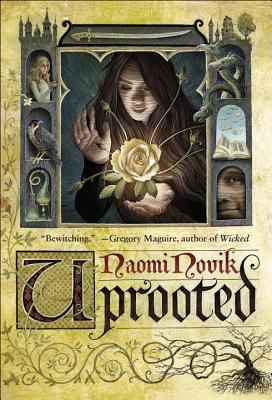
Review: Uprooted by Naomi Novik

Title: Uprooted

Author: Naomi Novik

Information on series: Not part of a series

Audience: Adult, though with appeal for some older teens

Rating (scale of 1-5, with 5 being highest): 5

TL;DR: A character-driven fairy tale with Eastern European influences that explores the ideas of home and forgiveness (and just a touch of steamy romance).

Longer review: I’m not surprised that Uprooted was the top pick for the May 2015 LibraryReads list (Publication Date: May 19th). In fact, I was one of the librarians who recommended it for the LibraryReads list after I lost most of a weekend reading it. A colleague had picked up an ARC at the 2014 ILA Conference, and passed it on to me with high praise when she finished.

Naomi Novik has been on my radar for several years because of her Temeraire series about an alternate history Napoleonic war with dragons. Many readers have told me how much they’ve enjoyed a recommendation for His Majesty’s Dragon, but somehow it’s never made it off of my TBR list. After reading Uprooted, though, His Majesty’s Dragon has moved up the list.

Uprooted is a coming-of-age fairy tale with a charming first person narrator and detailed, but not overwhelming, worldbuilding. Novik draws on the myths and legends of Russia and Eastern Europe, an influence that helps to differentiate this story from the more typical Celtic or Scandinavian fantasy settings. The story is set in a distant valley of the fictional Polnya near the border of hostile Rosya and the dangerous Wood (a forest filled with aggressive danger).

This is a story of self-discovery and forgiveness, and though it is very character-driven there is a fast moving plot. Agnieszka, our narrator, is 17 years-old and nothing about her is particularly special, though her family loves her. Perhaps her family loves her even more because she is such a failure at sewing, cooking, and almost any activity other than getting into messes outside. Agnieszka’s best friend Kasia, on the other hand, is a paragon of perfection and beauty, much to everyone’s despair.

Once every ten years the Dragon, a powerful wizard who protects Polnya from the Wood, selects a 17 year-old girl from the valley to serve him in his Tower. Because the Dragon holds himself apart from the locals, the girls he chooses are isolated for their ten years of service from friends and family, and they inevitably return so changed that they move to the distant capital to start new lives. So it’s obvious to everyone that come the 1st of October, the Dragon will choose Kasia as his servant and Agnieszka will lose her best friend. Of course, SPOILERS!, nothing goes as expected and the Dragon instead takes awkward, clumsy Agnieszka away from her beloved home.

There’s a touch of romance, which is steamy enough that it might be off putting to some readers, but the focus is on how the characters, especially Agnieszka, grow and change. Novik escalates the stakes throughout the story creating the sort of tension that left me reading well into the night. Uprooted is an engrossing fairy tale that I suspect I will be rereading in the near future.

Read alikes:
His Majesty’s Dragon by Naomi Novik: This is the first title in Novik’s series about an alternate history Napoleonic Wars with dragons.

Poison Study by Maria V. Snyder: The first of a fantasy trilogy featuring an unusual female heroine and a darker romance. Yelena is offered a reprieve from her death sentence for murder if she agrees to become the new poison taster for the repressive leader of her country where anyone with magical talent is killed.

Shadow and Bone by Leigh Bardugo: The first book in Bardugo’s Grisha trilogy also features a heroine with unexpected powers and a setting influenced by Eastern European culture. Though this series is intended for a teen audience and has a focus on the currently popular love triangle.

The Girl of Fire and Thorns by Rae Carson: This is also the first book of a Young Adult trilogy, though it stands well on its own. The setting is more reminiscent of Spain, but Elisa, the novel’s narrator, is a young woman who has a similar path of growth and self-discovery with a touch of romance that by no means defines her.

~Sarah, Carnegie-Stout Public Library