Title: Court of Fives
Author: Kate Elliott
Information on series: First in Court of Fives trilogy
Audience: Teens, though some adults will enjoy as well
Rating (scale of 1-5, with 5 being highest): 4
TL;DR: A novel about presumptions, prejudice, and incredible athletic feats (think Ninja Warrior). A good mix of action and character-development that should appeal to dystopian fans, despite it's fantasy setting.
Longer review: If you love action-packed dystopian novels, especially those featuring rebellious teens in a battle against repressive societies, but you're feeling burned out on futuristic wastelands, this might be the book for you. Court of Fives is set in a world based in part on the societies of ancient Egypt, the Aztec empire, and ancient Rome. This is Elliott's first young adult novel, but she's written several popular series for adults.
I loved the setting, and the complex relationships between the different cultures. The city of Saryenia is ruled by a rigid class structure, where the elite are conquerors from a foreign empire (or refugees from an empire shattered by Civil War) and the commoners are the remnants of a once powerful, darker skinned native society. Intermarriage between the two groups is strictly forbidden, which puts the main character's, Jessamy's, family in a precarious position. Jessamy's father is an accomplished military commander, and her mother is a low born commoner, placing Jessamy and her sisters somewhere in between.
The story is told from Jessamy's perspective, as she struggles between her love for her family and her dreams to be a champion at the Fives, a dangerous sport similar to Ninja Warrior. If you're not sure what Ninja Warrior is, I recommend checking out this video. The fact that we see Jessamy's world so tightly from her perspective sets up some nice surprises later in the novel as we learn that Jessamy's assumptions about her sisters and their goals were not always based on truth.
There is a romantic sub-plot to the novel, and of course it is a forbidden romance. Some readers will enjoy the lack of a love triangle (at least in this first volume), but I found that the love story added a layer of distraction to a fairly packed plot. It's likely that, were I still a teen reader, I would've loved this element of the book, but as an adult, I was rolling my eyes.
Read alikes:
The Hunger Games by Suzanne Collins: The big name action-packed dystopian novel, with a capable female lead on a quest to save her family.
Seraphina by Rachel Hartman: Seraphina's incredible musical talents bring her to the attentions of the royal palace as murder and political intrigue threaten to collapse the fragile peace between humans and dragons. SPOILER ALERT: Everything becomes even more complicated as Seraphina realizes she is the child of a forbidden romance between a human and a dragon.
~Sarah, Carnegie-Stout Public Library
Showing posts with label world building. Show all posts
Saturday, October 31, 2015
Wednesday, August 26, 2015
Review: The Hundred Thousand Kingdoms by N.K. Jemisin

Author: N.K. Jemisin
Information on series: First in The Inheritance Trilogy
Audience: Adult, though with appeal for some older teens
Rating (scale of 1-5, with 5 being highest): 3.5
TL;DR: A dark love story set against a complicated backdrop of political intrigue where the stakes are life or death.
Longer review: N.K. Jemisin's debut novel, The Hundred Thousand Kingdoms, introduces a complex world of political intrigue where it is deadly dangerous to be among the elite or too far outside the norm. Unfortunately Yeine, our protagonist, is a descendant of both the ruling Arameri and the "barbaric" Darre. Centuries past, the Arameri conquered the world with the aid of the god of light, Itempas, and suppressed all other religions- and gods. Yeine's mother gave up a position of power as the Arameri heir to marry a Darre man, and lived out her life in exile for her choice. But shortly after her mother is murdered, Yeine is called to the capital by her grandfather to join the competition to become his new heir.
This is not an easy read. It is dark and sometimes confusing. I almost abandoned The Hundred Thousand Kingdoms before I finished it, but I stuck with it from a combination of sheer stubbornness and the appeal of the twisted romantic subplot. I am a sucker for any variation on the story of Psyche and Cupid, though this is more of a hint than anything close to a retelling. Fair warning, this book does contain a sex scene and there are no warm fuzzies. Everyone has hidden motivations; if morality is a spectrum, most characters lean away from the good end of the scale.
While The Hundred Thousand Kingdoms stands well on its own, readers will probably appreciate seeing how the story of these characters and their world plays out over the next two books in The Inheritance Trilogy. There is a diversity of cultures to this world that we are first led to believe is a mono-culture under the strict control of the Arameri. That Yeine's Darre people secretly hold some of their ancient beliefs and practices along with their darker complexions is easily assumed to be an exception. Jemisin created a very detailed world for this series, and it was difficult to appreciate or (for me, at times) to even grasp all of the meaning in a single reading. By looking at the same world, and some of the same events, from different perspectives in the second and third books, I gained a much clearer picture of the larger story.
That said, the murkiness of this book, where I was never quite sure of the motivations behind various characters actions or what their goals were, fit the themes of balance between light and dark or order and chaos rather well. That Yeine is trying to navigate this precarious, ill-defined space in her identity as outsider and elite, serves to emphasize the theme. This is one of several themes that Jemisin continues to examine and expand on throughout the series. I may've picked up The Hundred Thousand Kingdoms for a romantic fantasy, but I love The Inheritance Trilogy for a complexity that continues to make me think.
~Sarah, Carnegie-Stout Public Library
Read alikes:
The Fifth Season by N.K. Jemisin: The first book in her third series, which was just published in August, The Fifth Season also features unique worldbuilding (the main magical power is literally worldbuilding or at least a power over mountains, earthquakes, etc.), and a main character whose powers make her an outsider.
The Emperor's Soul by Brandon Sanderson: A novella length story featuring an unusual female protagonist trapped by the ruling elite. A faster-paced story with more of an emphasis on action, but still featuring well developed, complex characters that touches on some interesting questions of identity.
Wednesday, July 22, 2015
Review: Name of the Wind by Patrick Rothfuss
Author: Patrick Rothfuss
Information on series: Part 1 of the Kingkiller Chronicles, an incomplete trilogy.
Audience: Adult
Rating (scale of 1-5, with 5 being highest): 5
TL;DR: A talented and charismatic hero takes his first steps toward greatness, power, and a dark destiny.
I may have my nerd-card revoked for admitting this, but I have an astonishingly hard time finding fantasy novels that I can tolerate, let alone like. I don’t dislike the genre. I’ve played Dungeons & Dragons for years and am more than happy hold forth on gnomish subspecies or the relative merits of wizardry and sorcery (in fact, every time I go to the reference desk I’m secretly hoping that today will be the day someone comes in with a meaty question about orcs or displacer beasts). After some consideration, I’ve determined that the problem is usually one of tone. Many authors seem to confuse “epic” with “self-serious.” Others veer in the opposite direction and produce novels that are just long strings of dwarf and elf jokes. In The Name of the Wind, Patrick Rothfuss strikes a refreshing balance between dour and frivolous and spins an engrossing tale of monsters, magic, and intrigue.
As the book opens, we learn that the main character, Kvothe, is a man of legendary power, known by such awed appellations as “Kvothe the Bloodless,” “Kvothe the Arcane,” and “Kvothe Kingkiller.” However, fate has turned against him and, following some undisclosed calamity, he’s holed up in a backwater hamlet waiting to die. When he’s discovered by a collector of legends, Kvothe agrees to relate his story and the book takes off, careening through forests, alleys, taverns, and palaces, detailing the creation and destruction of a hero.
The story that follows definitely prioritizes atmosphere and narrative voice. Rothfuss doesn’t aim for action movie pacing, but instead takes his time building complicated characters in a fully realized world. Plot elements move into place slowly and deliberately, forming a complex structure.
Rothfuss balances self-importance and self-effacement in a very concrete and effective manner. The young Kvothe of the main story is clever and ambitious, convinced of his own brilliance and eager to prove it to the world. At the same time, the older Kvothe of the framing story is all too aware of the tragic folly of his younger days and undercuts the heroics with a wry fatalism. This duality is riveting, drawing the reader in for both the vicarious thrill of success and the train-wreck voyeurism of defeat.
Not that anyone knows the full extent of Kvothe’s power or the exact nature of his downfall. The Name of the Wind is the first book of a trilogy. The second book, The Wise Man’s Fear, was published in March of 2011. The final book, tentatively titled The Doors of Stone, doesn’t have a release date and can’t come soon enough.
Read alikes:
The Magicians by Lev Grossman: Another trilogy-opener in which a powerful hero heads off to a magic academy. Good for the many fantasy readers who like that particular vein of world building in which theories of magic are detailed.
The Neverending Story by Micheal Ende: Though written for a younger audience, The Neverending Story may appeal to readers who enjoyed story-within-a-story structure of Name of the Wind and its grand mythic elements.
Ship of Magic by Robin Hobb: For readers looking to delve further into high fantasy. Captain Althea Vestrit fights to protect her magically sentient sailing vessel from pirates and slavers. Hobb’s story unfolds at a leisurely pace, making room for plenty of world-building detail and character development.
Readlikes suggested by Jillian:
Blood song by Anthony Ryan
The Warded man by Peter Brett
A lot of Robin Hobb’s other books would appeal, as well.
*back to impatiently awaiting book #3*
Review by Andrew Fuerste-Henry --Carnegie-Stout Public Library
Labels:
adult,
Anthony Ryan,
coming-of-age,
epic fantasy,
fantasy study,
large cast of characters,
Lev Grossman,
Michael Ende,
older teens,
Patrick Rothfuss,
Peter Brett,
Robin Hobb,
world building
Tuesday, June 30, 2015
Review: Rosemary and Rue by Seanan McGuire
Title: Rosemary and Rue
Author: Seanan McGuire
Series: October Daye
Audience: Teen/Adult
Rating: 5 stars
TL;DR: October Daye, a changeling P.I., is compelled under threat of death to solve the murder of Countess Evening Winterrose.
Longer review: Half-fae
private investigator October “Toby” Daye is building her life with her
husband and daughter in the mortal world, when a case she is working for
her liege goes south, and the bad guys turn her into a fish.
Fourteen
years later, the spell has worn off and Toby has reappeared in the
mortal world. Her mortal husband and daughter want nothing to do with
the wife and mother who they think abandoned them, and Toby wants
nothing to do with the Summerlands.
Understandably
bitter, Toby is keeping her head down and just trying to readjust to
life. But when Countess Evening Winterrose, one of Toby’s few friends
from Fairie, is viciously murdered shortly after she calls Toby begging
for help, Toby is drawn back into a world she hates.
What
makes this book incredible is McGuire’s easy writing style, her
well-developed characters, and the depth of her world-building. Once you
sink into this book, you’ll have to be dragged out of it. Better yet,
there are currently eight books in the series, with at least five more
planned.
McGuire is a prolific author, with two series under her own name, and another two under her pen name Mira Grant.
Read alikes:
Marie Brennan’s Onyx Court series: Set in Elizabethan London, the first book in this series, Midnight Never Come,
follows Michael Deven, a mortal courtier in Elizabeth’s court and Lune,
a fairie lady sent to manipulate Queen Elizabeth’s spymaster. Although
this book is set in a different time and place than McGuire’s series,
there are similarities in the court politics and the interaction between
the Fae and mortal worlds.
Kat Richardson’s Greywalker series:
Set in Seattle, this series features P.I. Harper Blaine, who, after a
near fatal accident, develops the ability to see and move through the
Grey – the realm of ghosts, witches, vampires and magic. Like October
Daye, Harper Blaine is a tough woman dealing with both real and
otherworldly problems.
Teresa Dahlgren
Waterloo Public Library
Friday, May 8, 2015
Review: Half a King by Joe Abercrombie
Author: Joe Abercrombie
Information on series: First of Shattered Sea trilogy, second book Half the world published 2015; final installment Half a war expected 2016.
Audience: Young Adult/New Adult, with Adult crossover potential
Read alikes: Traitor’s blade, by Sebastien de Castell; The Emperor’s blades by Brian Staveley; Prince of fools by Mark Lawrence; Grace of Kings by Ken Liu;Assassin’s apprentice by Robin Hobb
Rating (scale of 1 – 10, with 10 being the highest): 8
Recommended to: Reluctant fantasy readers as it is light on fantastical elements; fans of political/royal thrillers set in a different world; someone looking for something similar to but shorter and less violent than A Song of Ice and Fire (Game of Thrones)
Tl;dr: A page turning coming-of-age tale set in a Nordic/Viking world with a fair share of deception and betrayal, but with redeeming themes of friendship and loyalty.
“I spent half my childhood in the shadows. Hiding from my father or my brother. Creeping from a place of solitude to another. Seeing while unseen, and pretending I was a part of what I saw. Making up a life where I wasn't an outcast.”
Review:
Yarvi was never supposed to be King of Gettland. Born with a malformed hand he spent his time studying languages and maps, reading ancient texts and learning plant lore while preparing for life as a Minister, adviser and counselor to the royal family. But when his father and his older brother are murdered by a rival country’s king, he suddenly finds himself seated upon the Black Throne. Despite his physical handicap Yarvi is determined to prove his worth as a ruler and swears an oath to avenge his father and brother’s killers. When things don’t go quite as planned he finds himself in hostile environments far from home fighting for his life.
This book has it all: adventure on the high seas, treachery and back-stabbing, vengeance and violence, twists and turns aplenty. There’s a very minor romantic element but the true relationships are developed between the cast of well developed (though not necessarily likeable) characters. There’s enough action and dialogue to keep a reluctant fantasy reader engaged and the world-building is solid but not overbearing (no footnotes or family trees needed here). The overall tone is more melancholy and bleak which goes against more traditional epic fantasy. There are also few fantastical elements or magic, only a couple passing mentions of elves that used to inhabit the land long, long ago.
Though it is technically part of a trilogy (the third and final installment expected in 2016), there is enough closure that it could easily stand alone. It is also fairly short when compared to other fantasy novels, which will also appeal to reluctant readers or those new to the genre that may be overwhelmed by the prospect of beginning a lengthy series. The protagonist is implied to be in his late teen years, though his actual age is never mentioned. For this reason it could be promoted as Young Adult despite lacking many traditional YA tropes. Additionally, the violence and gore that is ubiquitous in Abercrombie’s earlier works has been significantly toned down.
Friday, April 17, 2015
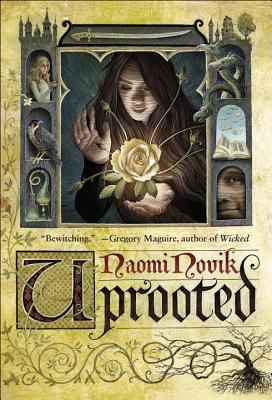
Review: Uprooted by Naomi Novik
Author: Naomi Novik
Information on series: Not part of a series
Audience: Adult, though with appeal for some older teens
Rating (scale of 1-5, with 5 being highest): 5
TL;DR: A character-driven fairy tale with Eastern European influences that explores the ideas of home and forgiveness (and just a touch of steamy romance).
Longer review: I’m not surprised that Uprooted was the top pick for the May 2015 LibraryReads list (Publication Date: May 19th). In fact, I was one of the librarians who recommended it for the LibraryReads list after I lost most of a weekend reading it. A colleague had picked up an ARC at the 2014 ILA Conference, and passed it on to me with high praise when she finished.
Naomi Novik has been on my radar for several years because of her Temeraire series about an alternate history Napoleonic war with dragons. Many readers have told me how much they’ve enjoyed a recommendation for His Majesty’s Dragon, but somehow it’s never made it off of my TBR list. After reading Uprooted, though, His Majesty’s Dragon has moved up the list.
Uprooted is a coming-of-age fairy tale with a charming first person narrator and detailed, but not overwhelming, worldbuilding. Novik draws on the myths and legends of Russia and Eastern Europe, an influence that helps to differentiate this story from the more typical Celtic or Scandinavian fantasy settings. The story is set in a distant valley of the fictional Polnya near the border of hostile Rosya and the dangerous Wood (a forest filled with aggressive danger).
This is a story of self-discovery and forgiveness, and though it is very character-driven there is a fast moving plot. Agnieszka, our narrator, is 17 years-old and nothing about her is particularly special, though her family loves her. Perhaps her family loves her even more because she is such a failure at sewing, cooking, and almost any activity other than getting into messes outside. Agnieszka’s best friend Kasia, on the other hand, is a paragon of perfection and beauty, much to everyone’s despair.
Once every ten years the Dragon, a powerful wizard who protects Polnya from the Wood, selects a 17 year-old girl from the valley to serve him in his Tower. Because the Dragon holds himself apart from the locals, the girls he chooses are isolated for their ten years of service from friends and family, and they inevitably return so changed that they move to the distant capital to start new lives. So it’s obvious to everyone that come the 1st of October, the Dragon will choose Kasia as his servant and Agnieszka will lose her best friend. Of course, SPOILERS!, nothing goes as expected and the Dragon instead takes awkward, clumsy Agnieszka away from her beloved home.
There’s a touch of romance, which is steamy enough that it might be off putting to some readers, but the focus is on how the characters, especially Agnieszka, grow and change. Novik escalates the stakes throughout the story creating the sort of tension that left me reading well into the night. Uprooted is an engrossing fairy tale that I suspect I will be rereading in the near future.
Read alikes:
His Majesty’s Dragon by Naomi Novik: This is the first title in Novik’s series about an alternate history Napoleonic Wars with dragons.
Poison Study by Maria V. Snyder: The first of a fantasy trilogy featuring an unusual female heroine and a darker romance. Yelena is offered a reprieve from her death sentence for murder if she agrees to become the new poison taster for the repressive leader of her country where anyone with magical talent is killed.
Shadow and Bone by Leigh Bardugo: The first book in Bardugo’s Grisha trilogy also features a heroine with unexpected powers and a setting influenced by Eastern European culture. Though this series is intended for a teen audience and has a focus on the currently popular love triangle.
The Girl of Fire and Thorns by Rae Carson: This is also the first book of a Young Adult trilogy, though it stands well on its own. The setting is more reminiscent of Spain, but Elisa, the novel’s narrator, is a young woman who has a similar path of growth and self-discovery with a touch of romance that by no means defines her.
~Sarah, Carnegie-Stout Public Library
Information on series: Not part of a series
Audience: Adult, though with appeal for some older teens
Rating (scale of 1-5, with 5 being highest): 5
TL;DR: A character-driven fairy tale with Eastern European influences that explores the ideas of home and forgiveness (and just a touch of steamy romance).
Longer review: I’m not surprised that Uprooted was the top pick for the May 2015 LibraryReads list (Publication Date: May 19th). In fact, I was one of the librarians who recommended it for the LibraryReads list after I lost most of a weekend reading it. A colleague had picked up an ARC at the 2014 ILA Conference, and passed it on to me with high praise when she finished.
Naomi Novik has been on my radar for several years because of her Temeraire series about an alternate history Napoleonic war with dragons. Many readers have told me how much they’ve enjoyed a recommendation for His Majesty’s Dragon, but somehow it’s never made it off of my TBR list. After reading Uprooted, though, His Majesty’s Dragon has moved up the list.
Uprooted is a coming-of-age fairy tale with a charming first person narrator and detailed, but not overwhelming, worldbuilding. Novik draws on the myths and legends of Russia and Eastern Europe, an influence that helps to differentiate this story from the more typical Celtic or Scandinavian fantasy settings. The story is set in a distant valley of the fictional Polnya near the border of hostile Rosya and the dangerous Wood (a forest filled with aggressive danger).
This is a story of self-discovery and forgiveness, and though it is very character-driven there is a fast moving plot. Agnieszka, our narrator, is 17 years-old and nothing about her is particularly special, though her family loves her. Perhaps her family loves her even more because she is such a failure at sewing, cooking, and almost any activity other than getting into messes outside. Agnieszka’s best friend Kasia, on the other hand, is a paragon of perfection and beauty, much to everyone’s despair.
Once every ten years the Dragon, a powerful wizard who protects Polnya from the Wood, selects a 17 year-old girl from the valley to serve him in his Tower. Because the Dragon holds himself apart from the locals, the girls he chooses are isolated for their ten years of service from friends and family, and they inevitably return so changed that they move to the distant capital to start new lives. So it’s obvious to everyone that come the 1st of October, the Dragon will choose Kasia as his servant and Agnieszka will lose her best friend. Of course, SPOILERS!, nothing goes as expected and the Dragon instead takes awkward, clumsy Agnieszka away from her beloved home.
There’s a touch of romance, which is steamy enough that it might be off putting to some readers, but the focus is on how the characters, especially Agnieszka, grow and change. Novik escalates the stakes throughout the story creating the sort of tension that left me reading well into the night. Uprooted is an engrossing fairy tale that I suspect I will be rereading in the near future.
Read alikes:
His Majesty’s Dragon by Naomi Novik: This is the first title in Novik’s series about an alternate history Napoleonic Wars with dragons.
Poison Study by Maria V. Snyder: The first of a fantasy trilogy featuring an unusual female heroine and a darker romance. Yelena is offered a reprieve from her death sentence for murder if she agrees to become the new poison taster for the repressive leader of her country where anyone with magical talent is killed.
Shadow and Bone by Leigh Bardugo: The first book in Bardugo’s Grisha trilogy also features a heroine with unexpected powers and a setting influenced by Eastern European culture. Though this series is intended for a teen audience and has a focus on the currently popular love triangle.
The Girl of Fire and Thorns by Rae Carson: This is also the first book of a Young Adult trilogy, though it stands well on its own. The setting is more reminiscent of Spain, but Elisa, the novel’s narrator, is a young woman who has a similar path of growth and self-discovery with a touch of romance that by no means defines her.
~Sarah, Carnegie-Stout Public Library
Labels:
adult,
character-driven,
coming-of-age,
Eastern European,
fantasy study,
high fantasy,
Leigh Bardugo,
Maria V. Snyder,
Naomi Novik,
older teens,
Rae Carson,
romance,
world building
Thursday, March 5, 2015
Review: The Southern Reach Trilogy by James VanderMeer
Title: The Southern Reach Trilogy
Author: James
VanderMeer
Information on series: 3
titles: Annihiliation, Authority, and Acceptance
Audience: Adult
Rating (scale of 1-10): 9
TL;DR: Area
X. Engulfing an ill-defined swath of land, sea and sky in the southern U.S., it
appeared suddenly,cutting off all connections from the rest of the world.
Eleven expeditions have been sent over the border, none have returned
unscathed, And yet, the agency that oversees each of these doomed expeditions –
The Southern Reach – prepares a twelfth expedition.
Readalikes: Crouch End by Stephen King, H.P.
Lovecraft
Longer Review:
Area X. Engulfing an ill-defined swath of land, sea and sky in the southern U.S., it appeared suddenly, cutting off all connections – human, animal and otherwise – from the rest of the world. The government sends team after team – scientific and military – into Area X. Some disappear without a trace, others return badly damaged and still others return seemingly unharmed, only to die weeks or months later. Most communication and recording instruments are rendered useless once the border is crossed, the footage that does survive only deepens the mystery – and the growing horror – of Area X. Still, the agency that oversees each of these doomed expeditions – The Southern Reach – prepares a twelfth expedition.
VanderMeer’s Southern Reach Trilogy opens with Annihilation (February 2014) as four women – an anthropologist, a surveyor, a psychologist and a biologist – are sent into Area X. Neither the author nor the narrator (the biologist) use names, instead the characters are defined only by their professions, lending a clinical and dispassionate air to the narrative. Even though we observe the others and Area X through the biologists’ eyes, even she remains somewhat removed from us and from her team. But instead of alienating the reader from the narrator, it lends an odd kind of intimacy that continues throughout the trilogy.
The second book, Authority (May 2014) is told from the point of view of a man called only Control, who has been put in charge of The Southern Reach soon after end of the twelfth expedition – and the investigation into its fate – as Area X appears to infiltrate (or contaminate, depending on your perspective) the world outside its borders. The third book, Acceptance (September 2014) returns us to Area X and the similarly inscrutable organization attempting to oversee, explain and control it.
The language VanderMeer uses is deeply atmospheric and complex, at times, maddeningly so*, although here in Area X it is entirely appropriate. Area X itself defies explanation and even description, as if our view of it through the eyes of our semi-anonymous characters was obscured, with unseen or unknowable dimensions hovering right at the edge of our perception. This dawning horror of the unknown creates and maintains a nearly intolerable level of suspense as layer after layer is peeled back – at times reluctantly – exposing and obscuring Area X and the people drawn into its influence.
This series is one of those that you’ll want (or in my case, need) to read more than once and even then, it stays with you. It reminds me of Stephen King’s short story Crouch End, or anything by Lovecraft. Even the cover art on the paperback editions is worth studying – and then hiding safely away, lest Area X escapes.
~ Allison
* In the middle of reading Authority, I came across this word and had to share it.
Wednesday, January 14, 2015
Review: Boneshaker by Cherie Priest
Title: Boneshaker
Author: Cherie
Priest
Information on
series: The Clockwork Century: Book 1
Audience: YA, with adult crossover
Rating (scale of 1-5,
with 5 being highest: 4
TL;DR: A fast-paced and character driven fantasy
with steampunk, alternative history and zombies.
Longer Review: Set in the Pacific Northwest. In the early part of the civil war inventor
Leviticus Blue is commissioned by Russian prospectors to build a machine that
drills through ice. On the first test run Leviticus drilled
through the foundation of several buildings down town, destroying them and
unearthing a gas which causes those breathe it to turn into zombies. Sixteen years later, the city is walled up. Leviticus’ window, Briar, who has a tarnished
reputation, is living in the outskirts.
Her son, 15 year old Ezekiel has
decided to sneak back into the city to prove that his Father that he never met
wasn't such a bad guy after all. Briar goes in after him and they both encounter wild inventions, a mad scientist, zombies
and pirates along the way.
This is well written.
Fans of fantasy will find lots here.
The emphasis is more on steampunk and less on the zombies. The book gets bogged down in detail in spots, so the
reader may have to slow down to take it all in.
Most of the book is pretty action packed and it has strong
characters. Briar is a strong female protagonist. There is a bit of a mystery element as to
if Leviticus was really the evil person everyone thinks he was and Briar knows
more than she is telling everyone including Ezekiel.
Readalikes:
The Six Gun Tarot
by R.S. Belcher: For the reader who
wants to read more steampunk, zombies and alternate history. This takes place in an abandoned mine in
Nevada.
The Havoc Machine by Stephen Harper: This is a fourth book in a series but can be
read as a stand-alone. This has
zombies, a mad scientist and a dangerous machine.
Labels:
adult,
alternate-history,
character-driven,
Cherie Priest,
fantasy study,
fast-paced,
horror,
R.S. Blecher,
steampunk,
Stephen Harper,
suspenseful,
world building,
young adult,
zombies
Monday, January 12, 2015
Review: Red Rising by Pierce Brown
Title: Red Rising
Author: Pierce Brown
Information on the
Series: First in a planned trilogy
Rating: (on a scale
from 1-5 with 5 being the highest) 4
TL;DR: A tale set in a bleak future society torn by
class divisions follows the experiences of secret revolutionary Darrow, who
after witnessing his wife's execution by an oppressive government, joins a
revolutionary cell and attempts to infiltrate an elite military academy.
Longer Review: Pierce Brown’s debut novel Red Rising has drawn comparisons to The Hunger Games and Game of Thrones. Full disclosure, I read The Hunger Games trilogy and thought it was okay, and I never
finished Game of Thrones. After reading the book I can see similar themes
and story elements in Red Rising, but
I feel that the book stands on its own merits.
Brown
has created a richly detailed fantasy world that takes place in a dystopian
future, on Mars. There is a distinctive
class system, based upon colors. Darrow
is a Red, the lowest class on Mars. The
twist is that Darrow doesn’t actually live on Mars, he lives in Mars.
Reds are miners, they were sent to Mars to work below the surface in an
attempt to make the planet habitable for humans because Earth is dying. This process has been going on for
generations. The majority of Reds have
been kept in the dark about the fact that there is a thriving community on the
surface, they still believe that what they are doing is important for the
future of colonization on Mars. The life
expectancy of a Red is very short due to the dangerous nature of their jobs. As
a result, Reds marry quite young.
Darrow, and his wife Eo, are teenagers, 15 or 16 years old. Through a
series of events, including the execution of his wife, Darrow ends up living on
the surface with a rebel organization called the Sons of Ares. This
organization is determined to bring down the elite Gold ruling class by any means necessary. Darrow
is reinvented and gains admission to the Institute, an elite military academy
where the Gold families send their teenagers.
Far from a posh school where students are pampered, the Institute is brutal. Essentially every child at the academy is fighting to survive. In order to do so they must create alliances, betray friends, commit unspeakable acts, including killing the other students. While this is similar to The Hunger Games, it seemed more violent. Everything that happens at the school is manipulated by the Gold ruling elite. Politics play a huge role, and power can change in the blink of an eye. It will take every ounce of strength and wit for Darrow to survive. If his subterfuge is discovered, he will be killed immediately. Even if he isn't discovered his life is constantly in danger. Red Rising walks a fine line between YA and Adult. While the main protagonist (and antagonists) are teenagers, what happens in the book, in terms of violence and political intrigue, is decidedly adult.
Darrow
is a sympathetic hero initially, as the book progresses and he has to make
difficult decisions, he becomes less likeable. He has to survive the academy in
order to infiltrate the upper echelon of the Gold class. Along the way he loses pieces of himself and
at times even he is shocked and disgusted by his behavior. The Darrow we meet at the beginning of the
book is very different from the Darrow at the end of the book, but I found myself still rooting for him to survive and succeed. The story starts slow and the transformation
of Darrow before he enters the Institute drags on a little bit too long. Once he enters the school the story moves at
a much faster pace. If you haven’t read
Red Rising yet, you are in luck. Golden Son, the second book of the
trilogy was released in January. You
won’t have to wait a year, like I did, to find out what happens after the
conclusion of Red Rising. Given the success of The Hunger Games movies, I’m sure it will come as no surprise that Red Rising has been optioned as a movie
by Universal Studios. Whether the project moves beyond the “in development”
stage remains to be seen.
Why
the 4-star rating? As I said earlier,
the beginning of the book is slow. Brown
also uses slight differences in language to differentiate between the
classes. At times that was confusing. Additionally, there are so many characters introduced
as the story progressed, I found it difficult to remember who was who, and why
they were important. That being said, I can't wait to read Golden Son.
Readalikes:
In
a future toxic landscape, a community that lives in an underground silo is
rocked by the desire of Sheriff Holston, who has upheld the group's rules for
years, to go outside, setting in motion events that kindle the fire of
revolution. Like Red Rising, the protagonists in this fast-paced, dystiopian
science fiction book question the authoritarian government and find out that
only through bloody rebellion can they achieve a better world.
Centuries
after an apocalyptic nuclear war, the world's survivors compete for dwindling
resources as the wealthy secretly plan to depart for another planet, while
soldier-slave Threnody Corwin uses her super-powers to rise against a syndicate
that is murdering her fellow psions. For those interested in bleak, gritty,
far-future worlds where members of the oppressed underclasses challenge the
ruling elite.
Review by: Amy Muchmore, Carnegie-Stout Public Library
Subscribe to:
Comments (Atom)