Showing posts with label science fantasy. Show all posts

Thursday, July 23, 2015

Review: Catteni Series by Anne McCaffrey


Title: Catteni Series (or Freedom Series)
Freedom’s Landing
Freedom’s Choice
Freedom’s Challenge
Freedom’s Ransom

Author:  Anne McCaffrey
Information on Series: Four books, I’m reviewing them as a whole. 

Audience: Adult with YA appeal
Rating: (scale 1-5 with 5 being the highest): 4

TL;DR:  Fast-paced series about a strong female protagonist abducted by aliens, dropped on a planet with other captives, and their fight to survive.  Uncomplicated world building, surprisingly upbeat and at times romantic.  A good introduction to the writings of Anne McCaffrey with nary a dragon in sight.  

Longer Review: Kristin Bjornsen was kidnapped by the alien Catteni and forced into slavery on the planet Barevi.  Kris did not meekly accept her fate, she stole her master’s flitter and escaped into the forest.  After months of living, and surviving on her own, she sees what looks like another Catteni hunting party in flitters flying towards her location. When she looks closer, she realizes on of the flitters is being pursued by the others.  Kris saves the Catteni in the pursued flitter, knocks him unconscious, and then tries to return him to the main city on Barevi. They are both captured by the Catteni, put to sleep by some drug, loaded into spaceships and then dropped, along with hundreds of others, on yet another planet.  This, my friends, is when the story really begins. 

Initially the other dropped people (some human, some not) want to kill the Catteni, Zanial. Kris and a handful of other drops see the wisdom of keeping a Catteni alive for the time being.  Zanial can provide insight as to what their purpose is on this new planet.  Plus, Kris feels somewhat responsible for his situation even though his race is completely responsible for her situation. Kris is a good person despite what has happened to her. The Catteni deposit slaves on a planet and if they survive then the planet is safe to inhabit and colonize.  If they don’t survive, the Catteni move on and drop slaves on another planet.  The Catteni civilization operates as a caste system, and Zanial is of the highest caste.  A Catteni has never been dropped before, let alone one of his ranking.  Zanial, being pragmatic, says “I dropped, I stay”.  He accepts his fate and helps the rest of the drops survive. 

The new planet they land on isn’t quite as uninhabited as the Catteni think.  Yet another alien race, one nobody has heard of, uses the planet as a giant farm. There are cow-like creatures, terrifying native birds, and something that sucks all the garbage into the ground at night keeping the planet clean.  The garbage cleaner doesn't exactly differentiate between "garbage" and anything else on the ground.  When Kris and the others were first dropped, many were sucked into the ground by the garbage cleaner before they woke up from their drugged state.  The first three books chronicle the survival and colonization of this new planet, dubbed Botany, and Zanial’s desire to spark a rebellion amongst his own people against the alien race that controls the Catteni.  Yes, the Catteni are acting under orders from a superior race, the Eosi, and Zanial isn’t too happy about being under their thumb. The problem is, Zanial is stuck on Botany with no way to communicate with his fellow Catteni dissenters.  Or is he?

This was my first foray into the writing of Anne McCaffrey.  The Catteni series provides some interesting world building without being totally overwhelming.  There is a huge cast of characters and with each book that cast just gets bigger and bigger.  I found that if I just focused on Kris, Zainal, and a few other main characters, I didn’t get too lost or bogged down by who was who.  The books were written in the late to mid-1990s (with the exception of book 4) so I enjoyed the pop culture references.  These books are tame enough for the YA crowd, but they may or may not get some of these references.  

The fourth book, Freedom’s Ransom, was written about 4 years after the third. It provided a nice wrap up to the story while still leaving some questions open to the imagination.  There wasn’t much action and a whole lot of talking.  The story could have easily ended after book 3, but there wasn’t any harm in finishing off the series.  If you are curious about how Earth survived the Catteni invasion, then book 4 is a must read. 

The Catteni series is about life on other planets and the will to survive. The drops are of different races, but they quickly learn that by working together they will have a better chance of survival. Zanial, as the lone Catteni, manages to make the best of his terrible situation.  Imagine being the only member of the race that forced everyone else on Botany into slavery.  By accepting his fate, and following another leader instead of lording over the others, he is accepted as one of the group.  I love that Kris is a strong, capable, well respected female character. She stands on her own two feet and her strengths are applauded and recognized by her fellow drops.  

I read all four books in about a week making them feel like one long novel which is why I chose to review them as a whole.  After Freedom's Landing, each subsequent book contains a preface that summarizes the events from previous books. That would come in handy if you read the series over a long period of time and can't quite remember what happened in a previous book.  


Read Alikes:

The Left Hand of Darkness by Ursula K. Le Guin

While on a mission to the planet Gethen, earthling Genly Ai is sent by leaders of the nation of Orgoreyn to a concentration camp from which exiled prime minister of the nation of Karhide tries to rescue him.   


Ender's Game by Orson Scott Card

An expert at simulated war games, Andrew "Ender" Wiggins believes that he is engaged in one more computer war game when, in truth, he is commanding the last Earth fleet against an alien race seeking Earth's complete destruction. 


The Quantum Rose by Catherine Asaro


Kamoj Argali is the young ruler of an impoverished province on a backward planet. To keep her people from starving, she has agreed to marry Jax Ironbridge, the boorish and brutal ruler of a prosperous province. But before Argali and Ironbridge are wed, a mysterious stranger from a distant planet sweeps in and forces Kamoj into marriage, throwing her world into utter chaos.


Amy Muchmore, Carnegie-Stout Public Library

Thursday, March 5, 2015

Review: The Southern Reach Trilogy by James VanderMeer

Title: The Southern Reach Trilogy

Author: James VanderMeer

Information on series: 3 titles: Annihiliation, Authority, and Acceptance

Audience: Adult

Rating (scale of 1-10): 9

TL;DR: Area X. Engulfing an ill-defined swath of land, sea and sky in the southern U.S., it appeared suddenly,cutting off all connections from the rest of the world. Eleven expeditions have been sent over the border, none have returned unscathed, And yet, the agency that oversees each of these doomed expeditions – The Southern Reach – prepares a twelfth expedition.


Readalikes: Crouch End by Stephen King, H.P. Lovecraft

Longer Review:
Area X. Engulfing an ill-defined swath of land, sea and sky in the southern U.S., it appeared suddenly, cutting off all connections – human, animal and otherwise – from the rest of the world. The government sends team after team – scientific and military – into Area X. Some disappear without a trace, others return badly damaged and still others return seemingly unharmed, only to die weeks or months later. Most communication and recording instruments are rendered useless once the border is crossed, the footage that does survive only deepens the mystery – and the growing horror – of Area X. Still, the agency that oversees each of these doomed expeditions – The Southern Reach – prepares a twelfth expedition.

VanderMeer’s Southern Reach Trilogy opens with Annihilation (February 2014) as four women – an anthropologist, a surveyor, a psychologist and a biologist – are sent into Area X. Neither the author nor the narrator (the biologist) use names, instead the characters are defined only by their professions, lending a clinical and dispassionate air to the narrative. Even though we observe the others and Area X through the biologists’ eyes, even she remains somewhat removed from us and from her team. But instead of alienating the reader from the narrator, it lends an odd kind of intimacy that continues throughout the trilogy.

The second book, Authority (May 2014) is told from the point of view of a man called only Control, who has been put in charge of The Southern Reach soon after end of the twelfth expedition –  and the investigation into its fate – as Area X appears to infiltrate (or contaminate, depending on your perspective) the world outside its borders. The third book, Acceptance (September 2014) returns us to Area X and the similarly inscrutable organization attempting to oversee, explain and control it.

The language VanderMeer uses is  deeply atmospheric and complex, at times, maddeningly so*, although here in Area X it is entirely appropriate. Area X itself defies explanation and even description, as if our view of it through the eyes of our semi-anonymous characters was obscured, with unseen or unknowable dimensions hovering right at the edge of our perception. This dawning horror of the unknown creates and maintains a nearly intolerable level of suspense as layer after layer  is peeled back – at times reluctantly – exposing and obscuring Area X and the people drawn into its influence.

This series is one of those that you’ll want (or in my case, need) to read more than once and even then, it stays with you. It reminds me of Stephen King’s short story Crouch End, or anything by Lovecraft. Even the cover art on the paperback editions is worth studying – and then hiding safely away, lest Area X escapes.

~ Allison

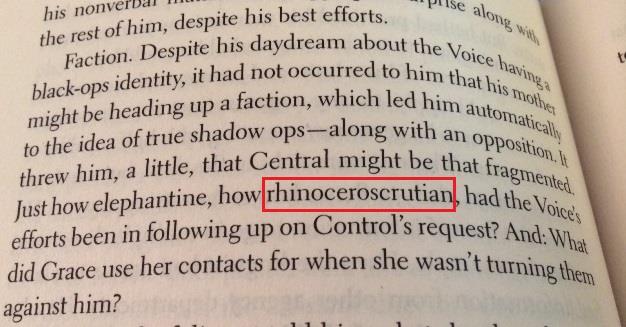
* In the middle of reading Authority, I came across this word and had to share it.
10006109_10204247464529226_578602301698060360_n

Wednesday, February 4, 2015

Review: The First Fifteen lives of Harry August by Claire North

Author: Claire North (pseudonym for Catherine Webb)
Information on series: Stand alone
Audience: Adult
Read alikes: Replayby Ken Grimwood; Life after life by Kate Atkinson; The impossible lives of Greta Wells by Andrew Sean Greer; My real children by Jo Walton
Rating (scale of 1 – 10, with 10 being the highest): 7.5


Tl;dr: A bit of a time travel tale mixed with a dose of Choose your own Adventure, this science-fiction/fantasy blend follows our protagonist Harry August as he navigates his life over and over again.  Harry is a kalachakra, one who is reborn into the same life while retaining memories of past lives, and has recently received a message from the future: The world is ending, and Harry may be the only one who can stop it. 

“When I am optimistic, I choose to believe that every life I lead, every choice I make, has consequence. That I am not one Harry August but many, a mind flicking from parallel life to parallel life, and that when I die, the world carries on without me, altered by my deeds, marked by my presence.” 

Meet Harry August. Harry is a kalachakra, an ouroboran, one who is reincarnated time after time as the same person. He follows a parallel path through life, experiencing the same major events, only to die and do it all over again. How he chooses to live each life is up to him, and Harry wears many hats over the course of the book. Harry’s lives all begin the same: born in an English train station on New Year’s Day 1919 his mother dies in childbirth, taking with her the secret of his father’s identity. Harry is raised by a groundskeeper and his wife and during his third life is inducted into a secret society comprised of other kalachakra, known as the Cronus Club. Under the guidance of the Club, Harry is educated in the ways of the kalachakra: You cannot change major events, no murdering Hitler as a child or preventing JFK's assassination. A kalachakra may use their knowledge of sporting events or stock patterns and benefit financially from these endeavors, though they must bequeath a good portion of their profits to the Club for future generations. Club members can pass information along to future or past kalachakra, either by finding an elderly ouroboran about to pass away and verbally giving them a message to carry back in time, or by carving a note in stone to be read by kalachakra to come. It is in this first manner that Harry receives a chilling message on the death bed of his eleventh life; the world is ending, faster and more violently with each reincarnation, and it is up to him to find out why.  Throughout his next four lives Harry sets out to determine the cause of the world's demise, a task that carries him around the globe, across the paths of past friends, enemies, and lovers, and delves deep into questions of philosophy, morality, mortality, hard science, and religion. As the culprit of the world's end is made known the book shifts from an exploration of Harry's lives on an emotional and metaphysical level to a discussion of scientific and technological advancements and their role in humanity. 

Conceptually, I thought this book was fantastic. While it is certainly not the first novel to play with timelines I felt the way the author handled reincarnation (being born again as the same person with prior lives' memories intact) was refreshing. Harry's first person narration is nonlinear as the plot jumps from life to life, often without preamble, which may be disconcerting to some readers. The pacing is also erratic, alternating between frustratingly stagnant to page-turning, which lowered my overall enjoyment. There were also times where the scientific concepts were above my own (extremely limited) grasp of quantum physics, though if that's a fault of the book or my knowledge I cannot say. 


Overall I found The first fifteen lives of Harry August to be quite a delightful read.