Showing posts with label lyrical. Show all posts

Wednesday, May 13, 2015

Review: Bone and Thunder by Chris Evans


Title: Of Bone and Thunder

Author: Chris Evans

Information on series: Not part of a series

Audience: Adult

Rating (scale of 1-10): 9


TL;DR: An excellent rendition of a soldier’s eye view of war, Of Bone and Thunder places fantasy features like dragons and wizards into a setting reminiscent of the Vietnam War.

Longer review:  The Kingdom is the world’s preeminent power, but its powerful military confronts a serious challenge when they begin an occupation of Luitox.  Their enemy, the Forest Collective, is almost indistinguishable from friendly Luitoxians, and expertly melt into the jungle which blankets Luitox’s high peaks and wide, swampy river valleys.
        The action follows several narrators, from ground-pounding crossbowmen Carny and Listowk, to rag (dragon) pilot Vorly, and inexperienced thaum (wizard) Jawn.  The novel jumps between narrators, and sometimes significantly forward in time.  Through a series of interconnected episodes, the soldiers recount their experiences while trying to make sense of their part in a conflict that is too large and complicated for them to understand.  Some seek solace in thoughts of home, or by embracing religion or the patriotic rhetoric of their leaders – others turn to apathy, or to drug abuse, or begin to embrace the violent work they have been conscripted to do.
        The world of Luitox feels fascinating and deep, in part because of the obvious, and very well-executed, extended metaphor with American involvement in Vietnam.  It is rewarding to come across historical similarities that the author has taken pains to incorporate, like the racial tension amongst the Kingdom’s soldiers - here between human and dwarf rather than between white and black.  Even the fantasy elements have historical parallels, right down to the whup whup whup sound of dragon wings echoing the rotor blades of Vietnam’s helicopters.
        While there is character development, this isn’t a bildungsroman; no one grows from boyhood to manhood, or rises from humble farmer to world savior.  Further, while the book ends with some resolution for the characters, it contains neither the beginning nor the end of the conflict in Luitox as a whole. The reader’s view of the big picture is restricted to the knowledge that the characters themselves possess.  This will make Of Bone and Thunder completely unsatisfying to people looking for high fantasy, but the book is no less great for that.  Author Chris Evans has created a really intimate and harrowing look at war as seen through the eyes of a common soldier, a perspective that is almost unique in the fantasy genre, and is well worth the read.

Read alikes: The novel’s point of view meant that the first read alikes that sprang to my mind were outside of fantasy.  Here are three books with similar perspectives – the points of view of regular soldiers during war.

Seven Men of Gascony, by R. F. Delderfield:  This is a classic work of military, historical fiction, which follows seven young Frenchmen conscripted into Napoleon’s army.  Through the victories, the horror of the retreat from Russia, and the reckoning of Waterloo, the friends fight to keep each other alive.  A bit older now, the novel shows some age in the more formal-sounding language, but does a far better job than more modern authors like Bernard Cornwell in illustrating the effects of war on ordinary soldiers.

Old Man’s War, by John Scalzi:  Great military sci-fi in which a squad of geriatrics is enlisted to fight humanity’s wars amongst the stars.  Though some characters go on to do big things later in the series, in this first volume they fight for survival and their squadmates as humans try to win colonies from a myriad of strange and sometimes violent inter-stellar races.  

The Things They Carried, by Tim O’Brien:  Perhaps the preeminent novel of the American soldier’s experience in Vietnam.  Of Bone and Thunder doesn’t include anything similar to O'Brien's interesting musings on the role of story in life, and probably isn’t destined to be a classic, but both books see the war intimately through the eyes of soldiers on the ground, and both have an episodic feel.

If you need a read alike from within fantasy, here are some books with action that falls outside the sword and sorcery fantasy tradition even if they don’t feel quite the same.

His Majesty’s Dragon by Naomi Novik:  Very much a military fantasy, even if it is more character driven, Novik introduces dragons into Napoleonic era warfare.  Probably would be really interesting to anyone who enjoyed the dragons and action in Of Bone and Thunder.  But it is pretty evident, even in this first of a nine-volume series, that Laurence and Temeraire are destined to great things and a leading role in their world.
Promise of Blood by Brian McClellan: An entertaining mix of mages and muskets.  This first book in a trilogy also follows several different warriors through their battles, and is also a bit of a change from the usual fantasy fighting conventions.  The characters involved, however, are clearly the major players in the overall story, so the feel is more like traditional fantasy.  Chris Evans, author of Of Bone and Thunder, has a trilogy (starting with A Darkness Forged in Fire) that sounds similar to McClellan’s books, but I haven’t read them, so I don’t know.

Review by: By Seth Warburton Ames Public Library

Wednesday, February 4, 2015

Review: The First Fifteen lives of Harry August by Claire North

Author: Claire North (pseudonym for Catherine Webb)
Information on series: Stand alone
Audience: Adult
Read alikes: Replayby Ken Grimwood; Life after life by Kate Atkinson; The impossible lives of Greta Wells by Andrew Sean Greer; My real children by Jo Walton
Rating (scale of 1 – 10, with 10 being the highest): 7.5


Tl;dr: A bit of a time travel tale mixed with a dose of Choose your own Adventure, this science-fiction/fantasy blend follows our protagonist Harry August as he navigates his life over and over again.  Harry is a kalachakra, one who is reborn into the same life while retaining memories of past lives, and has recently received a message from the future: The world is ending, and Harry may be the only one who can stop it. 

“When I am optimistic, I choose to believe that every life I lead, every choice I make, has consequence. That I am not one Harry August but many, a mind flicking from parallel life to parallel life, and that when I die, the world carries on without me, altered by my deeds, marked by my presence.” 

Meet Harry August. Harry is a kalachakra, an ouroboran, one who is reincarnated time after time as the same person. He follows a parallel path through life, experiencing the same major events, only to die and do it all over again. How he chooses to live each life is up to him, and Harry wears many hats over the course of the book. Harry’s lives all begin the same: born in an English train station on New Year’s Day 1919 his mother dies in childbirth, taking with her the secret of his father’s identity. Harry is raised by a groundskeeper and his wife and during his third life is inducted into a secret society comprised of other kalachakra, known as the Cronus Club. Under the guidance of the Club, Harry is educated in the ways of the kalachakra: You cannot change major events, no murdering Hitler as a child or preventing JFK's assassination. A kalachakra may use their knowledge of sporting events or stock patterns and benefit financially from these endeavors, though they must bequeath a good portion of their profits to the Club for future generations. Club members can pass information along to future or past kalachakra, either by finding an elderly ouroboran about to pass away and verbally giving them a message to carry back in time, or by carving a note in stone to be read by kalachakra to come. It is in this first manner that Harry receives a chilling message on the death bed of his eleventh life; the world is ending, faster and more violently with each reincarnation, and it is up to him to find out why.  Throughout his next four lives Harry sets out to determine the cause of the world's demise, a task that carries him around the globe, across the paths of past friends, enemies, and lovers, and delves deep into questions of philosophy, morality, mortality, hard science, and religion. As the culprit of the world's end is made known the book shifts from an exploration of Harry's lives on an emotional and metaphysical level to a discussion of scientific and technological advancements and their role in humanity. 

Conceptually, I thought this book was fantastic. While it is certainly not the first novel to play with timelines I felt the way the author handled reincarnation (being born again as the same person with prior lives' memories intact) was refreshing. Harry's first person narration is nonlinear as the plot jumps from life to life, often without preamble, which may be disconcerting to some readers. The pacing is also erratic, alternating between frustratingly stagnant to page-turning, which lowered my overall enjoyment. There were also times where the scientific concepts were above my own (extremely limited) grasp of quantum physics, though if that's a fault of the book or my knowledge I cannot say. 


Overall I found The first fifteen lives of Harry August to be quite a delightful read. 

Tuesday, February 3, 2015

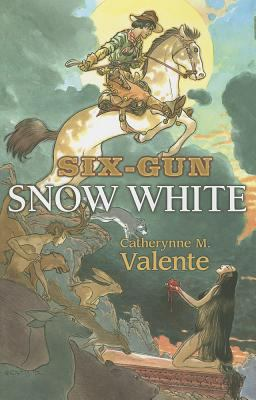
Review: Six-Gun Snow White by Catherynne M. Valente

 Title: Six-Gun Snow White

Author: Catherynne M. Valente

Information on series: Not part of a series

Audience: Adult, though with appeal for some older teens

Rating (scale of 1-5, with 5 being highest): 4.5

TL;DR: A violent, witty novella-length retelling of Snow White set in the Old West written with a very distinctive and lyrical narrative voice.

Longer review: My love of fairy tales brought me to the fantasy section as a child, and served as my gateway to dragons and wizards and all the rest. There is something magical about a well-written retelling that allows you to experience a familiar favorite, as if for the first time.

Catherynne M. Valente has drawn on myth and folklore in many of her award-winning novels and shorter fiction for both adults and younger readers (you might recognize her as the author of the middle-grade The Girl Who Circumnavigated Fairyland in a Ship of Her Own Making). Valente has described her style as “mythpunk” (à la cyberpunk). Her Six-Gun Snow White is, no surprise, a retelling of Snow White set in the American Old West.

What made Valente’s retelling stand out for me was the narrative voice. It’s a distinctive, witty style with grammar and vocabulary that brought the Old West setting and characters to life. This could very easily have become a gimmick, but instead the style helped to underscore what Valente had to say about gender, race, and magic. In fact, this proved to be the sort of book where I found myself going back to reread passages and mark favorite quotes. I’ll limit myself to sharing two here:

“In my experience, folk find it nigh on impossible to call a thing what it is.” (page 10)

“You can tell a true story about your parents if you’re a damn sight good at sorting lies like laundry, but no one can tell a true story about themselves.” (page 69)

It’s a violent, bittersweet story that will appeal most to readers who look for language and style over plot and characters. A taste for dark humor would not go amiss either.

Read alikes:

Pretty Deadly by Kelly Sue DeConnick, Emma Rios, & Jordie Bellaire: This graphic novel is another fairy tale set in the Old West, though it is an original tale that rather than a one-for-one retelling. The story is complex, and the artwork is often stunning.


The Ocean at the End of the Lane by Neil Gaiman: Like Valente, Gaiman often draws on folklore and mythology for inspiration in his stories. The mythology in The Ocean at the End of the Lane is familiar in the way that nightmares are familiar. This is also a novella, and the writing is lyrical, though it’s a very different poetry.


Deerskin by Robin McKinley: McKinley wrote some of the first fairy tale retellings I ever read, so it’s possible I’m including this more from nostalgia than for its appeal factors. That said, Deerskin is a dark story of abuse, escape, and recovery lyrically told.