Title: Court of Fives
Author: Kate Elliott
Information on series: First in Court of Fives trilogy
Audience: Teens, though some adults will enjoy as well
Rating (scale of 1-5, with 5 being highest): 4
TL;DR: A novel about presumptions, prejudice, and incredible athletic feats (think Ninja Warrior). A good mix of action and character-development that should appeal to dystopian fans, despite it's fantasy setting.
Longer review: If you love action-packed dystopian novels, especially those featuring rebellious teens in a battle against repressive societies, but you're feeling burned out on futuristic wastelands, this might be the book for you. Court of Fives is set in a world based in part on the societies of ancient Egypt, the Aztec empire, and ancient Rome. This is Elliott's first young adult novel, but she's written several popular series for adults.
I loved the setting, and the complex relationships between the different cultures. The city of Saryenia is ruled by a rigid class structure, where the elite are conquerors from a foreign empire (or refugees from an empire shattered by Civil War) and the commoners are the remnants of a once powerful, darker skinned native society. Intermarriage between the two groups is strictly forbidden, which puts the main character's, Jessamy's, family in a precarious position. Jessamy's father is an accomplished military commander, and her mother is a low born commoner, placing Jessamy and her sisters somewhere in between.
The story is told from Jessamy's perspective, as she struggles between her love for her family and her dreams to be a champion at the Fives, a dangerous sport similar to Ninja Warrior. If you're not sure what Ninja Warrior is, I recommend checking out this video. The fact that we see Jessamy's world so tightly from her perspective sets up some nice surprises later in the novel as we learn that Jessamy's assumptions about her sisters and their goals were not always based on truth.
There is a romantic sub-plot to the novel, and of course it is a forbidden romance. Some readers will enjoy the lack of a love triangle (at least in this first volume), but I found that the love story added a layer of distraction to a fairly packed plot. It's likely that, were I still a teen reader, I would've loved this element of the book, but as an adult, I was rolling my eyes.
Read alikes:
The Hunger Games by Suzanne Collins: The big name action-packed dystopian novel, with a capable female lead on a quest to save her family.
Seraphina by Rachel Hartman: Seraphina's incredible musical talents bring her to the attentions of the royal palace as murder and political intrigue threaten to collapse the fragile peace between humans and dragons. SPOILER ALERT: Everything becomes even more complicated as Seraphina realizes she is the child of a forbidden romance between a human and a dragon.
~Sarah, Carnegie-Stout Public Library
Showing posts with label suspenseful. Show all posts
Saturday, October 31, 2015
Tuesday, October 13, 2015
Review: The Rithmatist by Brandon Sanderson
Title: The Rithmatist
Author: Brandon Sanderson
Information on series: 1 in a series. Second book set to come out in 2017
Audience: Teen
Your rating: 5 of 5
TL;DR: Joel has wanted to be a Rithmatist, a person with the power to animate chalk drawings into Chalklings, his entire life. The son of a chalk maker, all he can do is watch those with that power prepare to defend the American Isles from Wild Chalklings.
Longer Review:
The Rithmatist is one of the most original works of fantasy I have read in quite awhile. Brandon Sanderson always seems to come up with fun and interesting new ideas for systems of magic. The Rithmatist is probably one of my favorites.
Joel goes to school at the elite Armedius Academy where wealthy and powerful "ordinary" students learn alongside those studying to be Rithmatists, strategists and soldiers with the ability to animate chalk drawings called Chalklings that pose the only defense against the Wild Chalklings that threaten the American Isles. Joel is neither wealthy nor a Rithmatist and his deep fascination of the art of Rithmatics makes him an outcast as someone who can't actually do it.
When students start disappearing from Armedius Academy, Joel is assigned to help the professor tasked with investigating the disappearances.
Joel is the best part about this book. He's a flawed character who desires things that are not possible and Sanderson doesn't give him the easy way out. Can't wait to read the next one in the series.
Readalikes:
Brandon Sanderson's many other novels, mostly for adults. The Mistborn Series is probably a good place to start.
Harry Potter is probably another good choice. It's another story of a kid at a school of magic who doesn't quite fit in (although for very different reasons).
Author: Brandon Sanderson
Information on series: 1 in a series. Second book set to come out in 2017
Audience: Teen
Your rating: 5 of 5
TL;DR: Joel has wanted to be a Rithmatist, a person with the power to animate chalk drawings into Chalklings, his entire life. The son of a chalk maker, all he can do is watch those with that power prepare to defend the American Isles from Wild Chalklings.
Longer Review:
The Rithmatist is one of the most original works of fantasy I have read in quite awhile. Brandon Sanderson always seems to come up with fun and interesting new ideas for systems of magic. The Rithmatist is probably one of my favorites.
Joel goes to school at the elite Armedius Academy where wealthy and powerful "ordinary" students learn alongside those studying to be Rithmatists, strategists and soldiers with the ability to animate chalk drawings called Chalklings that pose the only defense against the Wild Chalklings that threaten the American Isles. Joel is neither wealthy nor a Rithmatist and his deep fascination of the art of Rithmatics makes him an outcast as someone who can't actually do it.
When students start disappearing from Armedius Academy, Joel is assigned to help the professor tasked with investigating the disappearances.
Joel is the best part about this book. He's a flawed character who desires things that are not possible and Sanderson doesn't give him the easy way out. Can't wait to read the next one in the series.
Readalikes:
Brandon Sanderson's many other novels, mostly for adults. The Mistborn Series is probably a good place to start.
Harry Potter is probably another good choice. It's another story of a kid at a school of magic who doesn't quite fit in (although for very different reasons).
Wednesday, September 30, 2015
Review: The Library at Mount Char author Scott Hawkins

Title: The Library at Mount Char
Author: Scott Hawkins
Series: N/A
Audience: Adult
Rating: 4
TL;DR: What are twelve adopted godlings to do when their “Father” goes missing, leaving the power of his famous library up for grabs?
Longer review: On
Labor Day, 1977, a Pershing missile was dropped on the Garrison Oaks
subdivision in a futile attempt to kill a god. Twelve of the children
who survived the devastation thanks to the powers of “Father,” became
his apprentices.
Years
later, we meet Carolyn and her damaged and deranged “siblings”, as they
gather together to learn the fate of their Father, who has disappeared.
Who
will succeed him? The savage and brutal David, who has studied the arts
of war? Mad Margaret, who has been murdered and resurrected thousands
of times? Or will it be the quiet and crafty Carolyn, underestimated by
all her siblings? Which sibling will be the first to gain access to
Father’s vast and powerful library? And can these men and women manage
to rediscover the shreds of humanity that remain to them after the years
of physical, psychological and emotional abuse they underwent in order
to become gods?
Author’s Website: http://www.shawkins. net/
Read alikes
American Gods by Neil Gaiman.
Chronicles of Amber by
Roger Zelazny. If you enjoy the cut-throat sibling rivalry of The
Library at Mount Char, you might also enjoy the intrafamilial intrigue
of Zelazny’s series.
The Lost Swords series by Fred Saberhagen.
Review by Teresa Dahlgren, Waterloo Public Library
Monday, March 23, 2015
Review: The Cure for Dreaming by Cat Winters
Title: The Cure for Dreaming
Author: Cat Winters
Information on series: Not part of a series
Audience: Young Adult
Rating (scale of 1-5, with 5 being highest): 3.5
TL;DR: Historical fiction with a hint of fantasy. Highlights the struggle for women’s suffrage at the turn of the last century.
Longer review: This is Cat Winter’s second historical fiction book for a YA audience that has some fantasy/paranormal element. This book is set in 1900 in Portland, Oregon. The protagonist, Olivia Mead, is a pro-suffrage teenager who is struggling to assert her opinions or gain any freedom from her domineering and anti-suffrage father.
Author: Cat Winters
Information on series: Not part of a series
Audience: Young Adult
Rating (scale of 1-5, with 5 being highest): 3.5
TL;DR: Historical fiction with a hint of fantasy. Highlights the struggle for women’s suffrage at the turn of the last century.
Longer review: This is Cat Winter’s second historical fiction book for a YA audience that has some fantasy/paranormal element. This book is set in 1900 in Portland, Oregon. The protagonist, Olivia Mead, is a pro-suffrage teenager who is struggling to assert her opinions or gain any freedom from her domineering and anti-suffrage father.
Olivia is chosen to be hypnotized by Henri Reverie on Halloween night (also her birthday, this fact plays a very minor role). Olivia’s father sees this in the paper and hires Henri to hypnotize Olivia into more “ladylike” tendencies. Instead, Henri tells Olivia to “see the world as it is.” This results in Olivia seeing her father as a vampire (her favorite book is Bram Stoker’s Dracula) and suffragettes with a heavenly glow. Of course, there is a romantic element between Olivia and Henri. Together they team up to affect change and advance the efforts toward universal suffrage.
This book is a good introduction to fantasy for those who would not normally be inclined to read fantasy. The fantasy element is present, but there is no real world building beyond contextualizing the historical setting. Some of the message about free speech and rights is a little heavy handed at times, but that does go along with the storyline. Overall, it’s a quick read that may get some fantasy readers to learn about history or get some history lovers to appreciate the freedoms fantasy writing allows (humans doing things that they normally cannot). The romantic element is fairly chaste and is suitable for older middle school readers.
The story of one girl’s life throughout the first half of the 20th century. This story is largely historical fiction but may appeal to fantasy readers. The main character dies several times throughout the book, but is either able to change the past to prevent the fate or mysteriously defeats death.
In the Shadow of Blackbirds-Cat Winters.
Has a similar style and tone to The Cure for Dreaming, but set in 1918 during the height of the spiritualist movement and the Spanish Influenza. Features haunting pictures of the era to drive home how devastating the flu really was.
Thursday, March 5, 2015
Review: The Southern Reach Trilogy by James VanderMeer
Title: The Southern Reach Trilogy
Author: James
VanderMeer
Information on series: 3
titles: Annihiliation, Authority, and Acceptance
Audience: Adult
Rating (scale of 1-10): 9
TL;DR: Area
X. Engulfing an ill-defined swath of land, sea and sky in the southern U.S., it
appeared suddenly,cutting off all connections from the rest of the world.
Eleven expeditions have been sent over the border, none have returned
unscathed, And yet, the agency that oversees each of these doomed expeditions –
The Southern Reach – prepares a twelfth expedition.
Readalikes: Crouch End by Stephen King, H.P.
Lovecraft
Longer Review:
Area X. Engulfing an ill-defined swath of land, sea and sky in the southern U.S., it appeared suddenly, cutting off all connections – human, animal and otherwise – from the rest of the world. The government sends team after team – scientific and military – into Area X. Some disappear without a trace, others return badly damaged and still others return seemingly unharmed, only to die weeks or months later. Most communication and recording instruments are rendered useless once the border is crossed, the footage that does survive only deepens the mystery – and the growing horror – of Area X. Still, the agency that oversees each of these doomed expeditions – The Southern Reach – prepares a twelfth expedition.
VanderMeer’s Southern Reach Trilogy opens with Annihilation (February 2014) as four women – an anthropologist, a surveyor, a psychologist and a biologist – are sent into Area X. Neither the author nor the narrator (the biologist) use names, instead the characters are defined only by their professions, lending a clinical and dispassionate air to the narrative. Even though we observe the others and Area X through the biologists’ eyes, even she remains somewhat removed from us and from her team. But instead of alienating the reader from the narrator, it lends an odd kind of intimacy that continues throughout the trilogy.
The second book, Authority (May 2014) is told from the point of view of a man called only Control, who has been put in charge of The Southern Reach soon after end of the twelfth expedition – and the investigation into its fate – as Area X appears to infiltrate (or contaminate, depending on your perspective) the world outside its borders. The third book, Acceptance (September 2014) returns us to Area X and the similarly inscrutable organization attempting to oversee, explain and control it.
The language VanderMeer uses is deeply atmospheric and complex, at times, maddeningly so*, although here in Area X it is entirely appropriate. Area X itself defies explanation and even description, as if our view of it through the eyes of our semi-anonymous characters was obscured, with unseen or unknowable dimensions hovering right at the edge of our perception. This dawning horror of the unknown creates and maintains a nearly intolerable level of suspense as layer after layer is peeled back – at times reluctantly – exposing and obscuring Area X and the people drawn into its influence.
This series is one of those that you’ll want (or in my case, need) to read more than once and even then, it stays with you. It reminds me of Stephen King’s short story Crouch End, or anything by Lovecraft. Even the cover art on the paperback editions is worth studying – and then hiding safely away, lest Area X escapes.
~ Allison
* In the middle of reading Authority, I came across this word and had to share it.
Wednesday, January 14, 2015
Review: Boneshaker by Cherie Priest
Title: Boneshaker
Author: Cherie
Priest
Information on
series: The Clockwork Century: Book 1
Audience: YA, with adult crossover
Rating (scale of 1-5,
with 5 being highest: 4
TL;DR: A fast-paced and character driven fantasy
with steampunk, alternative history and zombies.
Longer Review: Set in the Pacific Northwest. In the early part of the civil war inventor
Leviticus Blue is commissioned by Russian prospectors to build a machine that
drills through ice. On the first test run Leviticus drilled
through the foundation of several buildings down town, destroying them and
unearthing a gas which causes those breathe it to turn into zombies. Sixteen years later, the city is walled up. Leviticus’ window, Briar, who has a tarnished
reputation, is living in the outskirts.
Her son, 15 year old Ezekiel has
decided to sneak back into the city to prove that his Father that he never met
wasn't such a bad guy after all. Briar goes in after him and they both encounter wild inventions, a mad scientist, zombies
and pirates along the way.
This is well written.
Fans of fantasy will find lots here.
The emphasis is more on steampunk and less on the zombies. The book gets bogged down in detail in spots, so the
reader may have to slow down to take it all in.
Most of the book is pretty action packed and it has strong
characters. Briar is a strong female protagonist. There is a bit of a mystery element as to
if Leviticus was really the evil person everyone thinks he was and Briar knows
more than she is telling everyone including Ezekiel.
Readalikes:
The Six Gun Tarot
by R.S. Belcher: For the reader who
wants to read more steampunk, zombies and alternate history. This takes place in an abandoned mine in
Nevada.
The Havoc Machine by Stephen Harper: This is a fourth book in a series but can be
read as a stand-alone. This has
zombies, a mad scientist and a dangerous machine.
Labels:
adult,
alternate-history,
character-driven,
Cherie Priest,
fantasy study,
fast-paced,
horror,
R.S. Blecher,
steampunk,
Stephen Harper,
suspenseful,
world building,
young adult,
zombies
Thursday, January 1, 2015
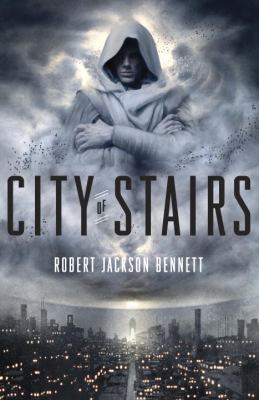
Review: City of Stairs by Robert Jackson Bennett
Author: Robert Jackson Bennett
Information on series: Not part of a series (EDIT: Has been picked up as the first in a series, second book expected in 2016)
Audience: Adult, though with appeal for some older teens
Rating (scale of 1-5, with 5 being highest): 4
TL;DR: A suspenseful mystery/spy mash-up with colorful characters that tackles complex issues of colonialism in a world where science has overthrown magic.
Longer review: Robert Jackson Bennett’s earlier books combined elements from the horror, fantasy, and mystery genres to create a creepy, bleak alternate early 20th century small town America. In City of Stairs, he presents a more straightforward fantasy novel, complete with imaginative world-building, while still incorporating elements from the pages of spy thrillers and mysteries. The use of a suspenseful mystery plot and a cast of very colorful characters makes this book a great choice for readers who are relatively new to fantasy.
The story is set in a world dominated by the island nation of Saypur, whose technological advancements (on par with the early 20th century) have completely upended the former world order. Saypur used their science to overthrow their former conquerors, the Continentals. The Continent was once gifted with divine magic, until those gods were killed by the Saypuri. Bennett explores the lasting impacts of colonialism and the ways that we define our cultural identities, while still maintaining an action-packed plot.
Shara has spent most of her adult life in exile on the Continent as an employee of the Saypuri Ministry of Foreign Affairs, specifically, as a spy for the Ministry. She is accompanied by Sigrud, her imposing and violent “secretary” with a mysterious past. Shara and Sigrud come to city of Bulikov to solve the murder of Effrem Pangyui, a Saypuri historian whose controversial research earned him no shortage of enemies. Bulikov was once a city of wonders, the cultural and religious center of the Continent, but now wallows in poverty and disease.
At 450 pages, this is not a short book, though the plot moves along so quickly I found it difficult to put down. Another point in City of Stairs’ favor is that it is not part of a larger series, so readers aren’t being asked to commit to three or more books that may or may not have been written yet. By the last pages, most of the plot threads are wrapped up more or less neatly, but between the imaginative setting and the interesting characters (the foul-mouthed female military commander, Mulaghesh, was probably my favorite), I would be perfectly happy if Bennett did write a sequel some day.
If this sounds like your cup of tea, you might also enjoy:
Review by Sarah Smith, Carnegie-Stout Public Library
Labels:
adult,
bureaucrats,
Carol Berg,
colonialism,
fantasy study,
gods,
Max Gladstone,
Michelle Sagara,
mystery,
older teens,
robert Jackson Bennett,
science fantasy,
suspenseful,
world building
Subscribe to:
Comments (Atom)